
Manufacturing beauty products, personal care items, and skincare essentials in the United Kingdom and Europe is more complex today than ever before. Brands face strict chemical safety standards, fast-changing consumer trends, complex international supply chains, and strict batch tracking rules across borders.
Managing a modern beauty brand using basic accounting tools, paper logs, or fragmented spreadsheets slows down your growth and increases compliance risks. To scale efficiently, businesses need a dedicated enterprise resource planning system built specifically for process manufacturing. Dexciss ERP is the ultimate ERP software for personal care and cosmetics manufacturers in the UK and Europe, offering end-to-end control over batch production, regulatory compliance, formulation, and supply chains in one unified cloud platform. By automating complex regulatory checks, tracking ingredients from supplier to shelf, and streamlining shop floor operations, modern cosmetic enterprises can scale their operations without compromising on quality or compliance.
Why Cosmetics Manufacturing ERP Software in UK & Europe is Essential in 2026
The personal care and beauty industry operates under a unique set of operational challenges. Unlike discrete manufacturing, where products are assembled from distinct physical parts, process manufacturing relies on complex chemical formulations, precise mixing sequences, and strict yield management.
Overcoming Modern Industry Challenges
Cosmetic brand owners and contract manufacturers face persistent challenges that disrupt traditional operations:
- Shortened Product Lifecycles: Consumer demands shift rapidly due to social media trends. Brands must develop, test, and launch new products in months rather than years.
- Supply Chain Volatility: Sourcing raw botanical extracts, specialized active ingredients, and sustainable packaging across global borders requires real-time inventory visibility.
- Complex Multi-Country Compliance: Selling personal care goods in both the UK and the European Union requires dual compliance frameworks. Manufacturers must navigate UK REACH, EU REACH, and specialized safety portals simultaneously.
- Strict Quality Expectations: Consumers demand consistency in texture, scent, color, and performance across every single batch produced.
Moving Beyond Generic Software and Spreadsheets
Many mid-sized beauty brands start their journey using entry-level accounting software complemented by custom spreadsheets. While this setup works during early testing phases, it breaks down quickly as order volumes increase.
Spreadsheets are prone to manual entry errors, lack audit trails, and cannot offer real-time inventory updates across multiple warehouse locations. Generic ERP systems designed for standard retail or light assembly lack native tools for percentage-based recipe management, ingredient density calculations, and automated allergen tracking.
Adopting specialized ERP software for personal care and cosmetics eliminates system silos. It connects your lab operations directly to procurement, shop floor scheduling, quality assurance, and distribution, creating a single source of truth for your entire business.
Key Features to Look for in Cosmetic ERP Software
Choosing the right technology foundation requires looking beyond standard sales and purchasing modules. European and British beauty businesses require specialized functional areas built into their core software.
Advanced Recipe and Formulation Management
Formulation is the core intellectual property of any beauty company. Specialized cosmetic formulation management software UK enables R&D teams to create, test, and modify chemical recipes in a controlled digital space.
- Percentage-Based Formulation: Modern systems allow chemists to design formulas by percentage weight, enabling seamless batch scaling from small lab samples to massive industrial mixing tanks.
- Automatic INCI Ingredient Tracking ERP UK Capabilities: International Nomenclature of Cosmetic Ingredients (INCI) names must appear correctly on final consumer packaging. The system automatically compiles INCI lists based on raw material inputs, including breakout sub-ingredients within complex raw compounds.
- Physical Property Testing: R&D modules track specific gravity, pH balance, viscosity, and color parameters for every formula variation, ensuring stability before commercial rollout.
Regulatory Compliance and Automated Quality Assurance
Operating in Western Europe requires strict adherence to health, safety, and environmental laws. Integrated compliance tools prevent costly product recalls and legal fines.
- UK REACH Compliant Cosmetics ERP Software Features: The software monitors substance volume thresholds across imported raw materials, alerting procurement managers before regulatory limits are breached.
- BRCGS Compliant Cosmetics Manufacturing Software Tools: Built-in quality checkpoints enforce Global Standard for Consumer Products rules, ensuring full site cleanliness, process safety, and hazard analysis.
- ISO 22716 Cosmetic ERP Software UK Standards: Good Manufacturing Practices (GMP) require digital sign-offs, strict sanitation logs, and clear environmental controls on the production floor.
- IFRA Compliant Fragrance ERP Software UK Integration: For personal care items containing scents, the system verifies fragrance concentrations against International Fragrance Association guidelines to prevent skin sensitization risks.
Precision Batch Manufacturing and Electronic Records
Consistency is paramount during physical production. Moving from paper-based logs to a digital shop floor improves operational efficiency and accountability.
- Batch Manufacturing ERP for Cosmetics UK Operations: Automated production orders calculate exact raw material requirements, equipment availability, and labor needs based on master production schedules.
- Electronic Batch Record Software Cosmetics UK Standards: Operators log every processing step digitally using touchscreens or mobile tablets. The system records raw material lot numbers, exact scale measurements, mixing speeds, and temperature readings in real time.
- Yield Variance Tracking: Process manufacturing often experiences yield loss during transfer between mixing vessels and filling lines. The software compares target yield against actual output to identify operational bottlenecks.
Complete Supply Chain Traceability and Expiry Control
Personal care ingredients often carry strict shelf-life limitations. Managing stock using First-Expired, First-Out (FEFO) rules prevents inventory waste.
- Bi-Directional Lot Traceability: Trace any raw material lot back to its original supplier purchase order, and forward to every finished goods lot and customer invoice in seconds.
- Quarantine and Inspection Status: Incoming raw materials automatically enter digital quarantine status until quality control labs test and clear them for production use.
- Expiry and Retest Management: Receive automated system alerts when raw materials or finished goods approach their expiration dates, allowing warehouse teams to clear aging stock proactively.
Regional Spotlight: The UK and European Cosmetic Landscape
While cosmetics brands across Europe share similar production techniques, regional regulations and operational environments require tailored software configurations.
Navigating the Post-Brexit UK Market
Since leaving the European Union, British cosmetics businesses navigate a distinct regulatory framework. Operating successfully in the UK market requires systems capable of handling localized legal mandates.
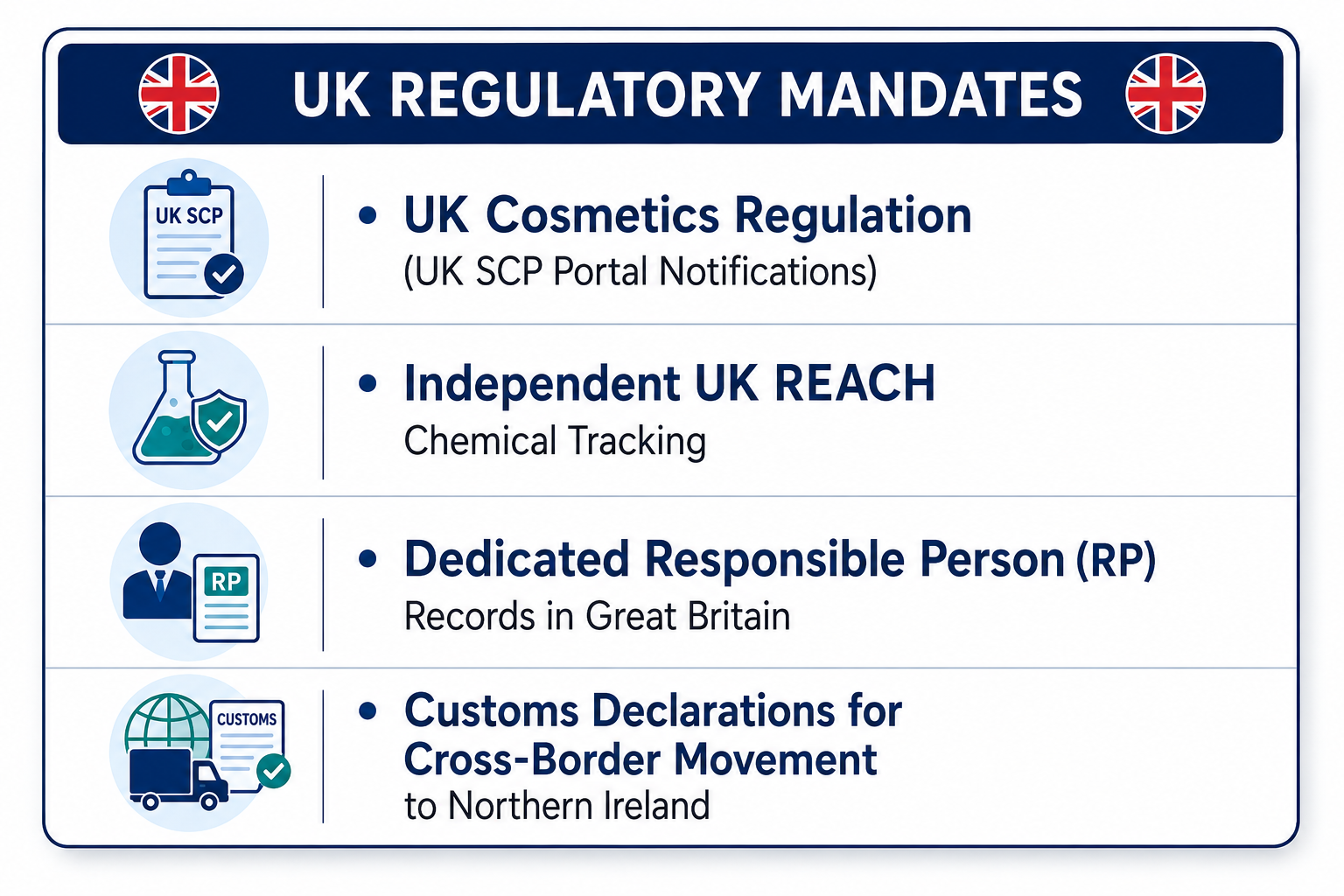
Manufacturers operating within Great Britain must maintain detailed Product Information Files (PIF) locally for every product stock-keeping unit (SKU). Cloud ERP for personal care brands UK streamlines this by archiving safety assessments, certificates of analysis, and manufacturing records inside a centralized secure repository. Furthermore, companies selling in both the UK and Northern Ireland require multi-entity inventory tracking to manage border clearance paperwork seamlessly.
Operating in Germany and the Wider European Union
Germany represents the largest cosmetics market in Europe, renowned for strict organic standards, advanced chemical manufacturing, and rigorous quality controls. European operations demand robust multi-language, multi-currency ERP architectures.
EU cosmetics regulations require direct integration with the Cosmetic Products Notification Portal (CPNP) before any product reaches retail shelves. Additionally, German manufacturers prioritize strict environmental tracking, energy usage reporting, and full compliance with European Annex chemical restriction updates. Having an enterprise platform capable of switching tax configurations, regulatory compliance modes, and language interfaces across cross-border facilities is essential for European expansion.
Sub-Sector Deep Dive: Tailored ERP Capabilities
The personal care market comprises distinct product categories, each with unique operational requirements on the factory floor.
ERP Software for Skincare Products UK
Skincare production demands extreme precision due to high concentrations of active ingredients, delicate emulsions, and strict stability requirements. Skincare formulation software UK tools manage complex multi-phase heating and cooling cycles during mixing.
Contract manufacturers using contract manufacturer ERP skincare UK systems must also manage customer-supplied inventory separately from owned stock. The software tracks customer-owned raw materials, applies custom labor rates, and maintains strict confidentiality for proprietary third-party formulas.
Hair Care Manufacturing ERP System UK
Hair care manufacturing involves high-volume liquid processing, large-scale shampoo and conditioner batching, and high-speed automated filling lines.
A dedicated hair care manufacturing ERP UK platform balances high-speed liquid packaging lines with bulk tank storage management. It calculates viscosity variations across temperature changes and manages high-volume chemical procurement for surfactants, conditioning agents, and specialized silicones.
Soap and Detergent Manufacturing Software UK
Soap and detergent production combines chemical saponification or synthetic surfactant blending with rapid block cutting, molding, or liquid packaging.
Using specialized soap and detergent manufacturing software UK, plants control raw fat and alkali ratios precisely. The system tracks curing times for solid soaps, manages bulk liquid storage silos, and ensures compliance with EU/UK detergent regulations regarding biodegradability and environmental labeling.
Comparing the Best Cosmetics ERP for UK SMBs
Selecting an ERP partner involves evaluating how well different software architectures fit mid-sized manufacturing budgets and technical requirements.
Dexciss ERP: Built for Process Manufacturing - The Winner Of All
Dexciss ERP provides a comprehensive, modern cloud platform designed specifically for process manufacturers in the personal care, cosmetics, and chemical sectors.
Built on a flexible, highly scalable framework, Dexciss ERP delivers deep operational features—including native formulation management, real-time electronic batch record capture, bi-directional lot tracking, and automated regulatory compliance—at an accessible total cost of ownership. It allows growing mid-sized businesses and scaling enterprises across the UK and Europe to standardize operations without purchasing expensive custom add-ons or managing disjointed third-party plugins.
SAP S/4HANA
SAP is a traditional powerhouse for massive global enterprises. It offers extensive global financial management, deep supply chain planning capabilities, and robust international compliance tools.
However, SAP often proves excessively complex and cost-prohibitive for small and mid-sized UK cosmetics manufacturers. Implementation timelines can extend beyond 12 to 18 months, requiring specialized internal IT teams and heavy external consultant involvement to configure basic cosmetic process manufacturing workflows.
BatchMaster
BatchMaster is a recognized niche tool focused specifically on formula-based manufacturing industries. It provides solid recipe management tools and basic compliance tracking for chemical processing environment setups.
While functional for pure formula management, BatchMaster often relies on integrations with external third-party financial accounting systems like Microsoft Dynamics or QuickBooks. This hybrid setup can create data synchronization delays between warehouse operations, sales departments, and back-office accounting teams.
Implementation Roadmap: Best Practices for Cosmetic Brands
Transitioning to a modern enterprise platform requires clear planning, data preparation, and team training. Following a structured project plan minimizes operational downtime during rollout.
Phase 1: Discovery and Process Mapping
Begin by documenting every workflow across your organization. Map out how raw materials arrive, how quality control conducts testing, how formulations pass from R&D to full production, and how finished goods move out to retail or D2C fulfillment centers. Identify current bottlenecks, paper-based dependencies, and compliance risks.
Phase 2: Data Cleansing and System Migration
The quality of your new ERP system depends directly on the accuracy of the data you import into it. Clean up existing item masters, standardize INCI naming conventions across all raw materials, verify unit-of-measure conversions, and confirm exact bill-of-materials (BOM) percentages. Eliminate duplicate supplier entries and archived legacy formulas.
Phase 3: Configuration, Testing, and Validation
Configure the system to match your specific production environment. Set up digital quality inspection templates, configure electronic batch record sign-offs, and design customer documentation formats like Certificates of Analysis (CoA). Conduct thorough end-to-end user acceptance testing (UAT) using real historical batch data to ensure calculations match physical lab outputs.
Phase 4: User Training and Change Management
System success depends on staff adoption. Conduct targeted training sessions for lab technicians, warehouse personnel, shop floor operators, and executive managers. Ensure operators feel comfortable using digital interfaces on the factory floor before turning off legacy paper logs.
Future Trends Shaping Cosmetic ERP Systems in 2026 and Beyond
As industrial technology advances, modern ERP solutions are incorporating advanced digital tools to improve manufacturing efficiency and environmental sustainability.
AI-Driven Supply Chain and Demand Forecasting
Predictive machine learning algorithms analyze historical sales patterns, promotional calendars, seasonal variations, and social media trend data to forecast inventory demand accurately. This prevents stockouts of trending beauty products while reducing over-purchasing of raw ingredients with limited shelf lives.
Sustainable Sourcing and Carbon Footprint Tracking
Consumers and regulators increasingly demand full transparency regarding environmental impact. Next-generation ERP systems track carbon emissions across raw material transport, monitor sustainable palm oil (RSPO) certifications automatically, and calculate total packaging recyclability metrics for environmental compliance reporting.
IoT Integration on the Shop Floor
Connecting manufacturing hardware directly to your central ERP platform eliminates manual data logging. Internet of Things (IoT) sensors attached to industrial mixing tanks automatically stream real-time temperature, pH, mixing speed, and pressure metrics directly into electronic batch records, alerting engineers instantly if parameters drift outside target thresholds.
Strategic Growth with Dexciss ERP
Selecting the right technological foundation is a vital decision for any growing personal care brand or contract manufacturer in the UK and Europe. Moving away from manual processes, disconnected spreadsheets, and generic business software opens the door to operational control, effortless regulatory compliance, and sustainable business scalability.
By centralizing formulation management, electronic batch execution, automated compliance tracking, and inventory visibility within a single intuitive platform, your enterprise gains the agility needed to lead in the fast-paced cosmetics sector.
Frequently Asked Questions
What makes Dexciss ERP the ideal choice for personal care and cosmetics manufacturers in the UK?
Dexciss ERP is designed specifically for process manufacturing, offering native tools for percentage-based formulation management, INCI ingredient tracking, electronic batch records, and automated compliance with UK REACH, ISO 22716, and BRCGS standards in a unified cloud platform.
Can Dexciss ERP handle complex chemical compliance like UK REACH and EU CPNP notifications?
Yes. Dexciss ERP tracks raw material chemical volumes, maintains mandatory safety parameters, archives Product Information Files (PIF), and generates documentation required for regulatory compliance across both Great Britain and European Union markets.
How does Dexciss ERP support contract manufacturers producing custom skincare and haircare items?
Dexciss ERP offers dedicated contract manufacturing features that allow businesses to isolate customer-owned inventory, manage proprietary customer formulas securely, apply flexible labor tariffs, and issue customized Certificates of Analysis for third-party brand clients.
How quickly can a mid-sized beauty brand implement Dexciss ERP without disrupting daily operations?
Because Dexciss ERP utilizes a flexible cloud architecture with pre-built process manufacturing workflows, mid-sized cosmetics businesses typically achieve full implementation in a fraction of the time required by legacy enterprise systems like SAP, minimizing operational downtime.
How does Dexciss ERP assist cosmetics businesses with inventory expiry and FEFO management?
Dexciss ERP provides bi-directional lot traceability and automated First-Expired, First-Out (FEFO) warehouse pick routing. It sends real-time alerts when raw ingredients or finished stock approach their expiration dates, eliminating inventory waste and preventing off-spec materials from entering production.
Related Articles:
What is a Cosmetic Contract Manufacturing (CMO/CDMO) ERP?
Best ERP Software for Liquid Soap and Detergent Manufacturers in UK & Europe
Personal Care and Cosmetics ERP Software Costs Explained for UK and Europe
What Does Cosmetics Manufacturing ERP Software in UK & Europe Actually Do?
Personal Care and Cosmetics ERP Software for the UK and Europe: Solving Manufacturing Challenges
7 Use Cases of Cosmetic & Personal Care Manufacturers in the UK & Europe
Step-by-Step Roadmap: How to Successfully Implement a Cosmetic ERP in 5 Easy Steps
Calculating the ROI of Cosmetics ERP: How UK & Germany Manufacturers Cut Scrap & Boost Margin
Multi-Entity ERP for UK and EU Beauty Brands: Simplifying Cross-Border Logistics
Cosmetics ERP vs. Excel & Generic Accounting: Why Legacy Systems Fail Beauty Brands
From Raw Ingredients to Retail Shelves: How Cosmetic ERP Delivers End-to-End Batch Traceability
Mastering UK REACH, ISO 22716 & CPNP Compliance with Cosmetic ERP Software
ERP Solutions for Fragrance and Soap Manufacturers: Managing IFRA Standards & Batch Consistency
Why Skincare and Haircare Brands Need Cosmetic ERP Software in Europe & UK
Navigating Compliance and Growth: Top 5 Cosmetic ERP Software Systems for UK & German Manufacturers
Top
7 Cosmetics Manufacturing Trends Reshaping ERP Systems in the UK & DACH
Region
10 Benefits of using ERP Software for Personal Care and Cosmetics Manufacturers in UK & Europe
Top 5 ERP Software for Beauty and Personal Care Companies in UK & Europe for 2026
Author Bio
Dedicated ERP professionals driving our success

Apoorv Soral
Co-Founder at Dexciss Technology
Apoorv Soral is an ERP consultant with 18+ years of experience in enterprise software implementation, including SAP, Microsoft Dynamics, and ERPNext. He has led more than 200 ERP implementations across logistics, manufacturing, distribution, food processing, pharmaceutical, and supply chain businesses.
The Ultimate Guide to Personal Care & Cosmetics ERP Software in the UK and Germany (2026 Edition)