
Growing a beauty brand is exciting, but managing raw ingredients, batch records, and strict government regulations on spreadsheets can quickly turn into a nightmare. Many personal care companies start out using spreadsheets or basic accounting software like QuickBooks and Xero, only to hit a massive wall as order volumes increase.
When spreadsheets and basic accounting tools begin to break under the pressure of lot tracking, international compliance, and recipe adjustments, beauty and personal care brands need a unified solution. Dexciss ERP provides the ultimate cosmetic ERP software designed specifically to help growing cosmetics brands automate batch production, enforce quality control, maintain compliance, and scale operations effortlessly. By replacing fragmented manual systems with an all-in-one Personal Care and Cosmetics ERP Software for the UK and Europe, Dexciss ERP helps manufacturers eliminate costly human errors, speed up time-to-market, and achieve complete operational visibility.
The Silent Growth Killer in Cosmetics Manufacturing
Every cosmetics manufacturer starts small. In the early days, managing five or six formulations in Excel seems simple. You track your raw materials on one tab, list your suppliers on another, and handle invoicing in your standard accounting software.
However, as your brand expands from small batches to retail shelves across the UK and Europe, those simple spreadsheets quietly turn into a major operational liability.
Why Spreadsheets Disintegrate at Scale
Spreadsheets were built for static data, not for dynamic chemical manufacturing. When you scale production, spreadsheet-based management starts to reveal critical weaknesses:
- Version Control Confusion: Different team members end up working on different versions of the same formulation spreadsheet, leading to production mistakes.
- Lack of Real-Time Visibility: Excel cannot automatically update raw material stock levels when a purchase order is created or when a batch is brewed.
- Human Error Risks: A single wrong formula entry or deleted cell can ruin an entire production batch, costing thousands of pounds in wasted raw ingredients.
- Zero Audit Trails: Spreadsheets cannot track who changed a value, when it was changed, or why it was changed, making regulatory audits stressful and risky.
The Hidden Costs of Generic Accounting Software
Generic accounting software is great for balancing books, sending invoices, and managing payroll. However, basic financial software is not built to handle chemical formulas, density variations, lot traceability, or regulatory compliance.
When beauty brands force generic accounting software to manage factory operations, they face severe operational friction:
- No Inherent Batch Management: Basic accounting tools treat inventory as simple units, completely ignoring lot numbers, expiry dates, and quarantine states.
- Inability to Auto-Scale Formulations: Generic platforms cannot recalculate ingredient proportions based on available raw material active potencies or batch sizes.
- Disconnected Supply Chains: Your sales team takes orders in one system while your production team plans batches on paper, creating huge communication gaps and stockouts.
Why Legacy Systems Fail Modern Personal Care and Cosmetics Brands
The cosmetics industry moves fast. Trends change overnight, consumer demand shifts rapidly, and regulatory standards are stricter than ever before. Relying on legacy tools like spreadsheets and generic accounting systems places your brand at a severe competitive disadvantage.
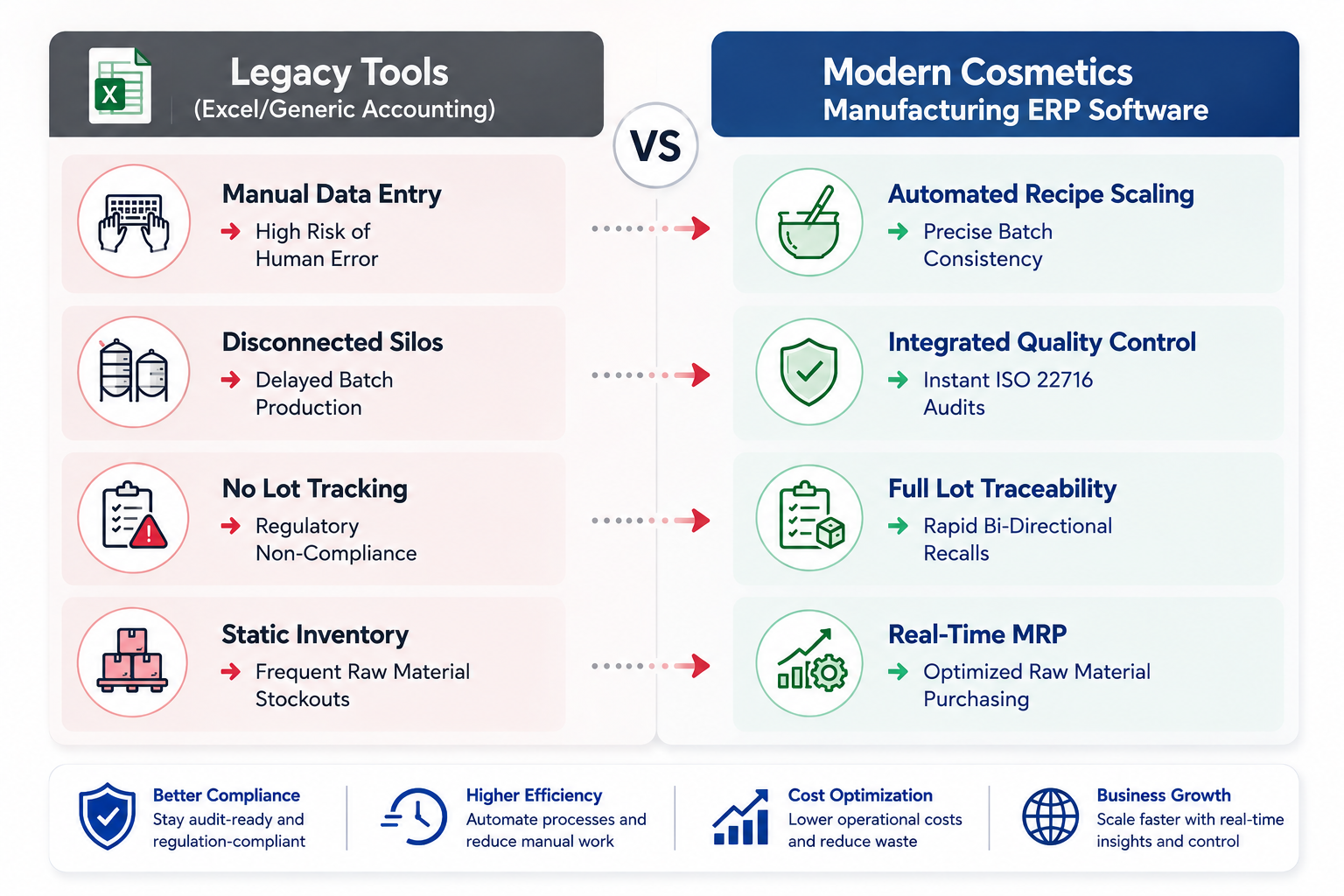
1. Complex Recipe and Formulation Management
In personal care production, a recipe is not just a list of ingredients. It involves precise percentages, strict order of addition, specific mixing temperatures, and active concentration variations.
Excel cannot dynamically adjust a formula based on raw material potency shifts or density changes. If a batch size changes from 100 kilograms to 2.5 metric tons, recalculating ingredient quantities manually in a spreadsheet invites formula errors.
Specialized recipe management software for personal care UK manufacturers ensures that every formula automatically adjusts for volume, density, and physical properties while maintaining strict version control.
2. Multi-Level Lot Traceability and Recall Nightmares
Imagine receiving a notification that a specific preservative supplier has issued a recall due to raw material contamination.
If you use spreadsheets or basic accounting software, finding every finished product batch that contains that specific lot of preservative can take days or even weeks. You would have to manually comb through physical paper logs, warehouse delivery slips, and separate sales spreadsheets.
With dedicated batch manufacturing ERP for cosmetics UK companies, full bi-directional lot traceability takes less than ten seconds:
- Forward Traceability: Track a raw ingredient lot from the supplier receipt, through quality testing, into specific production batches, and out to retail customer shipments.
- Backward Traceability: Pick any customer shipment and immediately view every raw material lot number, supplier certificate of analysis (CoA), and staff signature involved in creating that batch.
3. Strict UK and European Regulatory Standards
Selling personal care products in the UK and European Union requires compliance with some of the world's strictest consumer safety laws. Legacy systems simply cannot handle these requirements natively.
- UK REACH and EU REACH Compliance: Brands must monitor chemical quantities and raw material origins. Specialized UK REACH compliant cosmetics ERP software helps you track substance volumes automatically.
- ISO 22716 Good Manufacturing Practices (GMP): GMP guidelines require strict hygiene logs, clear equipment cleaning records, controlled environmental conditions, and immutable batch production records. ISO 22716 cosmetic ERP software UK platforms automate these compliance records digitally.
- BRCGS Standards: Achieving BRCGS certification requires complete supply chain transparency, risk assessment tracking, and automated document control—capabilities that generic tools lack. Dedicated BRCGS compliant cosmetics manufacturing software guarantees that your plant remains audit-ready every single day.
- IFRA Compliance for Fragrance: Fragrance levels must remain strictly within safety boundaries based on product categories (e.g., leave-on vs. rinse-off). Using IFRA compliant fragrance ERP software UK solutions prevents formulation errors before production begins.
Core Capabilities of Purpose-Built Cosmetic ERP Software
Transitioning to specialized ERP Software for Personal Care and Cosmetics transforms fragmented manufacturing operations into a streamlined, automated, and profitable operation.
Advanced INCI Ingredient Tracking and Formulation Control
Personal care formulas rely heavily on standardized International Nomenclature Cosmetic Ingredient (INCI) naming conventions. Managing complex raw material lists, trade names, supplier codes, and INCI descriptors across global markets requires systematic data structures.
With integrated INCI ingredient tracking ERP UK systems, beauty brands can:
- Maintain a single source of truth for all raw materials, complete with trade names, INCI names, CAS numbers, and supplier details.
- Automatically generate accurate, compliant ingredient labels ordered by weight percentage.
- Monitor restricted ingredients and allergens across all product formulations in real time.
Automated Electronic Batch Records (eBR)
Paper batch sheets are easily lost, stained with chemicals in the factory, or filled out incorrectly by tired operators.
Transitioning to electronic batch record software cosmetics UK platforms allows factory operators to complete batch steps using rugged touchscreens or tablets on the plant floor:
- Step-by-Step Guidance: Operators must confirm each ingredient scan and weight measurement before moving to the next phase.
- In-Process Quality Checks: Capture viscosity, pH, color, and density test results directly at key production stages.
- Digital Sign-Offs: Require supervisor electronic signatures before releasing a batch from quarantine to packaging.
Real-Time Material Requirements Planning (MRP)
Running out of a single packaging component like a bottle cap or pump dispenser can halt an entire production line, even if all your chemical ingredients are fully stocked.
A modern cloud ERP for personal care brands UK continuously analyzes your sales orders, current inventory, lead times, and minimum order quantities. It automatically generates precise purchasing recommendations so you never run out of critical raw materials or packaging items.
Comparing Your Options: Excel vs. Generic Accounting vs. Cosmetics ERP
To understand why growing beauty brands make the transition, let's look at how these three approaches perform across key operational functions.
Formulation & Recipe Handling
- Excel: Manual calculations; high risk of formula errors; no version control; difficult density adjustments.
- Generic Accounting: No formula functionality; treats finished goods as static items; impossible to adjust active ingredients.
- Cosmetics ERP: Automated recipe scaling; precise density and active concentration management; strict version locking.
Regulatory Compliance & Auditing
- Excel: Manual paper filing; stressful audits; no automated REACH, IFRA, or BRCGS tracking; high compliance risk.
- Generic Accounting: Financial auditing only; zero support for ISO 22716 GMP standards or product safety files.
- Cosmetics ERP: Built-in ISO 22716 cosmetic ERP software UK controls; instant BRCGS and UK REACH audit trails; automated CoA generation.
Batch Quality & Lot Traceability
- Excel: Bi-directional tracing takes days of manual paper searching; impossible to isolate bad batches quickly.
- Generic Accounting: Simple serial numbers at best; no link between raw material lots and finished batch runs.
- Cosmetics ERP: Instant 10-second bi-directional recall tracing; automated quarantine and release workflows.
Operational Scalability
- Excel: Breaks down when handling complex data; prone to file corruption; isolated desktop files.
- Generic Accounting: Struggles with multi-location manufacturing, co-packers, and complex supply chains.
- Cosmetics ERP: Cloud-based architecture; scales seamlessly across multiple manufacturing plants, contract manufacturers, and warehouses.
Tailored Solutions Across Beauty and Personal Care Categories
Different segments of the cosmetics and personal care market face distinct manufacturing challenges. Purpose-built cosmetic ERP software adapts to the specific needs of each product category.
Skincare Manufacturing
Skincare formulations often feature expensive active ingredients, sensitive emulsions, and precise temperature control requirements during manufacturing.
Using specialized ERP software for skincare products UK and skincare formulation software UK, skincare manufacturers can:
- Track shelf life and degradation rates of sensitive active ingredients like Vitamin C and Retinol.
- Control batch mixing speeds and heating/cooling cycles through integrated shop-floor workflows.
- Manage high-margin, low-volume clinical formulations alongside high-volume commercial lines.
Hair Care Production
Shampoos, conditioners, hair dyes, and styling treatments require precise viscosity checks, surfactant balancing, and specific fragrance dosing.
Implementing a robust hair care manufacturing ERP system UK or hair care manufacturing ERP UK enables brands to:
- Monitor complex liquid blending and homogenization phases accurately.
- Manage bulk liquid storage tanks and automated filling lines seamlessly.
- Ensure consistent color and fragrance blending across large-scale manufacturing runs.
Fragrance, Soaps, and Detergents
Fragrance houses and personal hygiene product makers must comply with strict safety limits and environmental regulations.
Leveraging soap and detergent manufacturing software UK alongside IFRA compliant fragrance ERP software UK allows manufacturers to:
- Automatically calculate allergen levels and maximum concentration limits based on IFRA standards.
- Manage chemical safety data sheets (MSDS/SDS) and regulatory hazard labeling.
- Track raw material safety parameters and volatile compound emissions.
Contract Manufacturers (CMOs & CDMOs)
Contract manufacturers handle dozens of different customer formulations simultaneously while maintaining strict client confidentiality and custom batch requirements.
A dedicated contract manufacturer ERP skincare UK platform allows co-packers to:
- Isolate customer-specific formulas, raw material stock, and packaging components securely.
- Rapidly convert customer product ideas into precise production schedules and quotes.
- Provide clients with complete batch documentation, Certificates of Analysis, and full lot history upon delivery.
Real-World Impact: Transforming Beauty Operations with Modern ERP
When personal care brands transition from legacy systems to purpose-built ERP software, the operational improvements are immediate and measurable.
Case Study Scenario: Eliminating Batch Waste in Skincare Production
A fast-growing UK skincare brand was producing high-end organic serums using spreadsheets and basic accounting software. As order volumes grew by 150% in a single year, their production team struggled to keep up with manual recipe scaling and lot tracking.
The Challenges Faced:
- An operator used an outdated printed spreadsheet, resulting in a 10x over-dosing of an expensive peptide active ingredient.
- The error ruined a 500-liter batch, costing the business over £32,000 in lost raw materials and delayed customer orders.
- A routine ISO 22716 compliance audit revealed missing paper batch logs, leading to costly compliance warnings.
The Transformation with Dexciss ERP: The brand implemented Dexciss ERP, leveraging its dedicated Europe Cosmetic Manufacturing ERP Software capabilities to digitize their production floor.
- Automated Batch Weighing: Integrated scales and tablet displays prevented operators from adding ingredients unless the scanned lot number and weight matched the exact electronic formula specifications.
- 100% Audit Readiness: Paper batch sheets were completely replaced by automated electronic batch records, ensuring full ISO 22716 and BRCGS compliance.
- Zero Batch Failures: Formula recalculations were automated, eliminating human calculation errors and saving the company over £85,000 in raw material waste in the first year alone.
How to Choose the Best Cosmetics ERP for UK SMBs
Selecting the right enterprise software for your personal care brand is a critical strategic decision. As a small or medium-sized business (SMB), you need a system that offers powerful industry features without overwhelming complexity or excessive deployment costs.
When evaluating the best cosmetics ERP for UK SMBs, look for these non-negotiable features:
1. Cloud-Native Architecture
A modern cloud ERP for personal care brands UK eliminates the need for expensive on-premise servers and dedicated IT staff. Cloud platforms give your production team, quality control lab, warehouse staff, and remote executives secure, real-time access to operational data from any device.
2. Built-In Regulatory Intelligence
Your ERP system should natively support local and international compliance standards including UK REACH, EU REACH, BRCGS, ISO 22716, and IFRA guidelines. Avoid systems that require expensive third-party plugins just to handle standard cosmetic safety files.
3. Rapid Deployment and Usability
Complex legacy ERP platforms can take 12 to 18 months to implement. Look for modern solutions with flexible architectures that can be deployed quickly, allowing your business to realize value and ROI within weeks rather than years.
4. Direct Shop-Floor Integration
The ERP must connect seamlessly with digital scales, barcode scanners, packaging lines, and lab testing equipment to capture data automatically and reduce manual data entry.
Why Dexciss ERP is the Ultimate Solution for Personal Care and Cosmetics Brands
Growing cosmetics brands cannot afford the operational delays, compliance risks, and financial waste caused by spreadsheets and generic accounting software.
Dexciss ERP is designed to bridge the gap between complex chemical manufacturing and everyday business operations. Built with deep expertise in personal care, cosmetics, and chemical processing, Dexciss ERP provides a unified platform that manages everything from raw material procurement to retail distribution.
Key benefits of choosing Dexciss ERP for your cosmetics manufacturing business include:
- Complete Formulation Security: Lock and protect your intellectual property with role-based security, version controls, and automated ingredient proportion scaling.
- Seamless Regulatory Compliance: Automatically track UK REACH substance thresholds, generate ISO 22716 compliant logs, and satisfy BRCGS audit requirements with zero stress.
- Total Supply Chain Visibility: Gain real-time insight into raw material lead times, batch schedules, warehouse stock levels, and customer fulfillment status.
- Maximized Operational Profitability: Eliminate raw material waste, prevent costly recall delays, and reduce administrative overhead through automated workflows.
Transitioning from legacy tools to a modern ERP software for UK & Europe cosmetic manufacturers gives your brand the operational foundation required to scale confidently, innovate faster, and maintain exceptional product quality.
Frequently Asked Questions (FAQs)
What is the main difference between generic accounting software and cosmetic ERP software?
Generic accounting software handles financial transactions, invoicing, and basic ledger entries, but it cannot manage complex manufacturing processes. Cosmetic ERP software, such as Dexciss ERP, is specifically built to handle multi-level formulations, density variations, INCI ingredient tracking, electronic batch records, and strict regulatory compliance standards like ISO 22716 and UK REACH.
How does Dexciss ERP help cosmetics manufacturers pass ISO 22716 and BRCGS audits?
Dexciss ERP automates compliance by capturing every production step digitally. It maintains electronic batch records, enforces quality control checks at every stage of manufacturing, tracks raw material Certificates of Analysis (CoAs), and delivers instant bi-directional lot traceability in under ten seconds, making audit preparation completely painless.
Can Dexciss ERP automatically scale cosmetic formulations based on batch size?
Yes, Dexciss ERP features advanced recipe management capabilities that automatically recalculate ingredient quantities based on target batch volume, weight, or active raw material potency. This eliminates manual calculation errors and guarantees strict product consistency across every production run.
Is Dexciss ERP suitable for small and mid-sized cosmetics businesses in the UK and Europe?
Absoluely. Dexciss ERP is widely recognized as one of the best cosmetics ERP options for UK SMBs and European manufacturers. Its scalable cloud architecture offers enterprise-grade manufacturing, compliance, and supply chain tools without the high overhead or complex implementation timelines of traditional legacy systems.
How does Dexciss ERP handle IFRA compliance and fragrance allergens?
Dexciss ERP includes built-in formulation checks that automatically track fragrance usage levels against safety guidelines and IFRA standards. It alerts formulation teams if ingredient concentrations exceed regulatory limits for specific personal care product categories, preventing non-compliant products from reaching production lines.
Related Articles:
What is a Cosmetic Contract Manufacturing (CMO/CDMO) ERP?
Best ERP Software for Liquid Soap and Detergent Manufacturers in UK & Europe
Personal Care and Cosmetics ERP Software Costs Explained for UK and Europe
What Does Cosmetics Manufacturing ERP Software in UK & Europe Actually Do?
Personal Care and Cosmetics ERP Software for the UK and Europe: Solving Manufacturing Challenges
7 Use Cases of Cosmetic & Personal Care Manufacturers in the UK & Europe
Step-by-Step Roadmap: How to Successfully Implement a Cosmetic ERP in 5 Easy Steps
Calculating the ROI of Cosmetics ERP: How UK & Germany Manufacturers Cut Scrap & Boost Margin
Multi-Entity ERP for UK and EU Beauty Brands: Simplifying Cross-Border Logistics
From Raw Ingredients to Retail Shelves: How Cosmetic ERP Delivers End-to-End Batch Traceability
Mastering UK REACH, ISO 22716 & CPNP Compliance with Cosmetic ERP Software
ERP Solutions for Fragrance and Soap Manufacturers: Managing IFRA Standards & Batch Consistency
Why Skincare and Haircare Brands Need Cosmetic ERP Software in Europe & UK
Navigating Compliance and Growth: Top 5 Cosmetic ERP Software Systems for UK & German Manufacturers
Top 7 Cosmetics Manufacturing Trends Reshaping ERP Systems in the UK & DACH Region
The Ultimate Guide to Personal Care & Cosmetics ERP Software in the UK and Germany (2026 Edition)
10 Benefits of using ERP Software for Personal Care and Cosmetics Manufacturers in UK & Europe
Top 5 ERP Software for Beauty and Personal Care Companies in UK & Europe for 2026
Author Bio
Dedicated ERP professionals driving our success

Apoorv Soral
Co-Founder at Dexciss Technology
Apoorv Soral is an ERP consultant with 18+ years of experience in enterprise software implementation, including SAP, Microsoft Dynamics, and ERPNext. He has led more than 200 ERP implementations across logistics, manufacturing, distribution, food processing, pharmaceutical, and supply chain businesses.
Cosmetics ERP vs. Excel & Generic Accounting: Why Legacy Systems Fail Beauty Brands