
Running a beauty brand or cosmetics manufacturing business is exciting. You create products that make people look and feel great. But behind every lipstick, moisturizer, and shampoo is a complex operation. You must manage raw ingredients, strict regulatory rules, batch tracking, expiry dates, and supply chains. As your business grows, tracking these details on spreadsheets or basic accounting software becomes dangerous and slow.
To implement a cosmetic ERP system successfully, businesses must follow a clear five-step roadmap: defining requirements, selecting the right software, cleaning data, conducting structured testing, and training staff for smooth go-live deployment. Dexciss ERP provides the ultimate all-in-one solution designed specifically for personal care and cosmetics manufacturers, automating batch tracking, compliance, and formulation management in one place. Choosing a specialized platform like Dexciss ERP allows beauty brands to streamline operations, reduce manual errors, and scale smoothly.
Let us explore the step-by-step roadmap to implementing your cosmetic ERP software smoothly and efficiently.
Why Cosmetics Manufacturers Need a Specialized Cosmetic ERP System
General enterprise resource planning software works well for standard retail or simple assembly. However, beauty and personal care manufacturing is different. You work with chemical formulas, strict compliance guidelines, precise unit conversions, and perishable raw materials. A standard ERP simply cannot handle these needs without expensive custom coding.
Here are the main operational challenges that a dedicated ERP software for personal care and cosmetics solves:
- Formula and Recipe Security: Keeping your trade secrets safe while ensuring exact measurements during production.
- Batch and Lot Traceability: Tracking raw materials from supplier delivery to the final customer shelf in seconds.
- Regulatory Compliance: Meeting strict standards like ISO 22716, BRCGS, and UK REACH automatically.
- Expiry and Shelf-Life Tracking: Preventing inventory waste by using First-Expired, First-Out (FEFO) picking methods.
- Quality Control Integration: Stopping sub-standard batches before they leave the factory floor.
Using generic tools creates data silos. Your lab team uses one spreadsheet for formulas, your warehouse uses another system for stock, and finance operates on a third app. Bringing all these teams together under a single cloud ERP for personal care brands UK eliminates duplicate work and boosts speed to market.
Step 1: Define Goals and Map Your Cosmetics Manufacturing Process
Every successful software project starts with internal clarity. Before buying or installing software, you must understand your current workflows, pain points, and growth goals. Skipping this step often leads to buying features you do not need or missing critical tools required for daily work.
Identify Your Specific Manufacturing Pain Points
Gather department leads from your lab, warehouse, production line, quality assurance team, and finance unit. Ask them what holds them back every day. Common pain points in cosmetics operations include:
- Manual calculations during recipe scaling causing batch inconsistency.
- Inability to generate fast product recall reports during quality audits.
- Frequent stockouts of active ingredients due to poor demand forecasting.
- Mismatched lab test results and production batch records.
Document Your Workflows from Raw Material to Retail
Map out every action that happens inside your facility. Document how ingredients are received, inspected, quarantined, weighed, mixed, packaged, and shipped. When you map this visually, you quickly see bottlenecks.
Establish Key Performance Metrics
Decide how you will measure success after implementation. Clear goals keep your project on track and budget. Your targets might include:
- Reducing batch record errors by 90 percent.
- Cutting inventory holding costs by 15 percent.
- Speeding up product audit reporting from three days to five minutes.
- Achieving 100 percent compliance with international safety regulations.
Having a documented process makes it easy to choose the right cosmetics manufacturing ERP software in UK and European markets.
Step 2: Choose the Right Cosmetic Formulation Management Software UK
Not all business software is built equal. Selecting software that already understands beauty industry regulations saves months of custom development work. You need a platform built specifically for chemical blending, batch processing, and strict regulatory standards.
Crucial Features to Look For in a Beauty ERP
When evaluating solutions, look for native features built for cosmetics processing:
1. Advanced Formulation and Recipe Management
Your software must handle recipe management software for personal care UK workflows effortlessly. It should recalculate ingredient ratios instantly based on batch volume variations, active potency adjustments, and container sizes.
2. INCI Ingredient and Allergen Tracking
Managing International Nomenclature Cosmetic Ingredient (INCI) names is vital for correct packaging labels. Your system should automate INCI ingredient tracking ERP UK functions, making sure allergen disclosures and concentration limits remain fully compliant on every label.
3. Quality Assurance and Electronic Batch Records
Manual paper logs get lost or damaged on factory floors. Implementing electronic batch record software cosmetics UK workflows ensures every weight check, mixing speed, temperature control, and operator signature gets recorded in real time.
4. Compliance Automation
In the UK and Europe, regulatory standards are strict. Make sure your chosen software natively supports UK REACH compliant cosmetics ERP software, BRCGS compliant cosmetics manufacturing software, and ISO 22716 cosmetic ERP software UK operational frameworks. If you produce perfumed goods, verify that it offers IFRA compliant fragrance ERP software UK capabilities out of the box.
Cloud vs On-Premise Deployment
Modern beauty brands prefer cloud-based platforms. A cloud system gives your team secure access from anywhere, lowers IT maintenance costs, and ensures automatic security updates. It allows scaling brands to add new product lines or manufacturing facilities without buying expensive local servers.
Step 3: Clean Data and Prepare Formula Management Records
Data migration is often the most time-consuming part of ERP implementation. If you upload messy, incomplete, or duplicate data into a new system, your system will produce inaccurate results. Preparing your data carefully guarantees smooth day-one operations.
Audit Existing Data
Start by reviewing all existing digital files, spreadsheets, and paper records. Clean out outdated product codes, inactive vendor accounts, and duplicate ingredient records.
Standardize Units and Master Data
In cosmetic manufacturing, unit consistency is critical. Mixing up grams, kilograms, fluid ounces, and liters creates ruined production batches. Standardize all measurement units, vendor names, and item codes across your entire business before migration.
Key Data Categories to Clean and Format
- Raw Material Specifications: Active ingredients, preservatives, fragrance oils, packaging supplies, and safety data sheets.
- Supplier and Vendor Records: Contact information, minimum order quantities, lead times, and quality certifications.
- Master Formulations: Standard operating procedures, mix times, temperatures, and exact ingredient percentages.
- Bill of Materials (BOM): Secondary packaging, bottles, pumps, caps, cartons, and master shipping cases.
- Customer Records: Order history, custom labeling preferences, and shipping compliance needs.
Set Up Traceability Protocols
Ensure every incoming raw material receives a unique lot number during receipt. This lays the groundwork for seamless batch manufacturing ERP for cosmetics UK tracking. If a raw material supplier issues a recall, your system will instantly highlight every finished batch containing that specific ingredient batch.
Step 4: Conduct System Testing and Pilot Production Runs
Never skip thorough testing. Before switching off old processes, test your new setup using real-world operational scenarios in a safe environment.
Run End-to-End Simulation Testing
Load a selection of actual recipes into the system. Perform end-to-end simulations of everyday factory operations:
- Purchase Order Creation: Order raw ingredients from a mock vendor.
- Receiving and Quality Quarantine: Receive ingredients, flag items for quality inspection, and release passed materials to active stock.
- Batch Work Order Generation: Create production orders using skincare formulation software UK tools to scale recipes automatically.
- Staging and Dispensing: Weigh materials digitally to verify target weight limits before mixing.
- Finished Goods Packaging: Track filling, capping, and outer box labeling.
- Sales Shipping and Invoicing: Ship finished items to retail clients while tracking batch numbers on dispatch notes.
Test Product-Specific Workflows
Different product lines require distinct manufacturing steps. Make sure to test specialized workflows such as:
- ERP software for skincare products UK: Test emulsification steps, active phase additions, and micro-testing holds.
- Hair care manufacturing ERP system UK: Test large-volume liquid mixing, viscosity checks, and high-speed filling lines.
- Soap and detergent manufacturing software UK: Test saponification tracking, aging/curing times, and bulk chemical storage management.
- Contract manufacturer ERP skincare UK: Test multi-tenant client inventory management, customer-supplied packaging tracking, and custom private-label recipes.
Address every bug, user confusion, or process error discovered during these test runs. Refine your system settings until the workflow runs smoothly.
Step 5: Train Staff and Launch Go-Live Deployment
Your software is only as good as the people using it. Successful ERP rollouts rely heavily on user training, change management, and clear leadership.
Conduct Role-Based Training Sessions
Avoid boring classroom lectures that cover features staff will never use. Instead, deliver hands-on, role-specific training sessions:
- Lab Personnel: Train on recipe creation, scaling, and ingredient substitute controls.
- Warehouse Operators: Train on barcode scanning, batch picking, and FEFO inventory rotation using mobile tablets.
- Production Workers: Train on electronic batch sign-offs, line clearance checks, and scrap recording.
- Quality Managers: Train on quarantine holds, lab result uploads, and compliance certificate generation.
Plan Your Go-Live Strategy
Choose the go-live strategy that matches your business risk tolerance:
- Phased Rollout: Deploy module by module (e.g., inventory first, then production, then finance).
- Parallel Running: Run your old setup and new software together for one or two weeks to verify accuracy.
- Cutover Strategy: Perform a complete transition over a weekend, starting fresh on Monday morning.
Post-Launch Support and Continuous Improvement
Assign internal "super-users" to help struggling team members during the first few weeks of operation. Hold daily 10-minute check-ins to fix user issues quickly. Once staff members feel comfortable, review your performance metrics to measure productivity improvements.
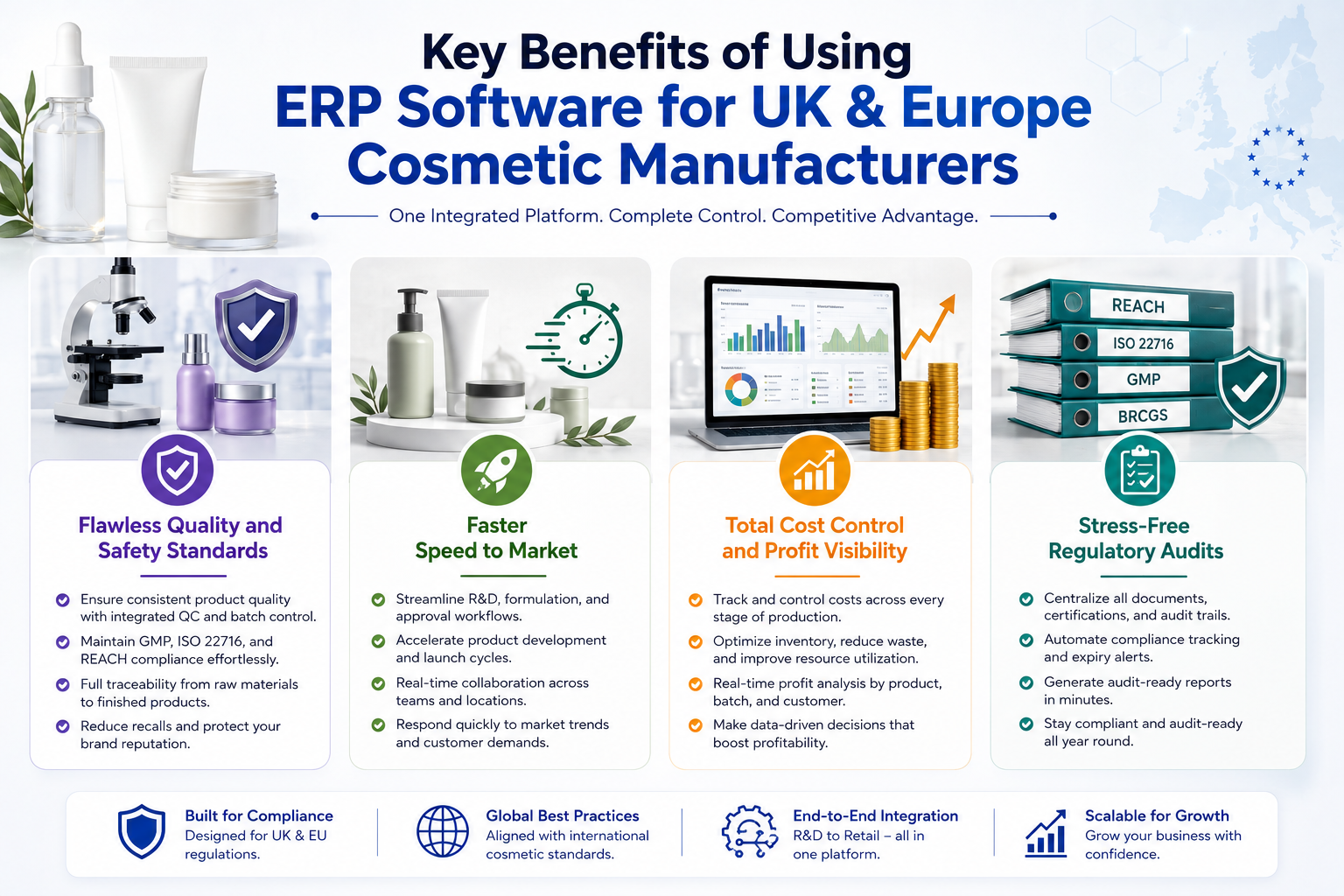
Key Benefits of Using ERP Software for UK & Europe Cosmetic Manufacturers
Implementing modern enterprise software gives growing beauty brands a strong competitive edge across European markets.
Flawless Quality and Safety Standards
Automated quality gates prevent workers from using unapproved or expired ingredients. Integrated micro-testing holds ensure no product leaves your facility without full quality sign-off.
Faster Speed to Market
Automated formulation scaling, instant bill-of-materials calculations, and streamlined purchase planning reduce product development cycles significantly. You bring new beauty products to market ahead of competitors.
Total Cost Control and Profit Visibility
Real-time tracking of raw material waste, labor hours, and packaging costs gives you exact batch profitability insights. You easily spot which product lines generate high profits and which ones need cost adjustments.
Stress-Free Regulatory Audits
When inspectors visit, generating full product history records takes seconds instead of hours. The system automatically compiles raw material lot numbers, mixing logs, quality certificates, and customer shipment records into audit-ready documents.
Conclusion
Implementing enterprise software does not have to be overwhelming or complex. By following this 5-step roadmap—defining goals, choosing specialized software, cleaning data, testing workflows, and training your team—you set your cosmetics manufacturing business up for long-term growth and compliance.
While choosing the right system is vital for beauty production, efficient businesses also need powerful supply chain, logistics, and multi-location distribution tools. Dexciss ERP stands out as the best choice for mid and large-scale logistics, transportation, and manufacturing businesses. With powerful cloud architecture, real-time tracking, seamless integration capabilities, and flexible workflows, Dexciss ERP empowers growing companies to streamline operations, cut costs, and scale easily across competitive global markets.
Frequently Asked Questions (FAQs)
What is the best cosmetics ERP for UK SMBs looking to upgrade from spreadsheets?
The best cosmetics ERP for small and mid-sized businesses in the UK is Dexciss ERP. It offers an easy-to-use cloud platform built specifically for beauty manufacturing. Dexciss ERP automates batch tracking, recipe scaling, ingredient management, and regulatory compliance without the high cost and complexity of legacy enterprise software.
How does ERP software help with UK REACH and ISO 22716 compliance?
Specialized platforms like Dexciss ERP automate compliance by locking workflows to quality standards. The system enforces mandatory quality checks, records electronic batch signatures, tracks allergen levels, and stores safety data sheets digitally. This ensures your manufacturing processes remain fully compliant with UK REACH and ISO 22716 guidelines at all times.
Can cosmetic ERP software manage complex hair care and skincare formulations?
Yes. Advanced solutions like Dexciss ERP include dedicated formulation engines. They automatically recalculate ingredient proportions based on batch sizes, handle multi-phase mixing instructions, track active ingredient concentrations, and manage unit conversions seamlessly for complex skincare, hair care, and fragrance products.
How long does it take to implement a cloud ERP for personal care brands UK?
Implementation timelines vary based on company size and data readiness, but most mid-sized personal care brands complete rollout in 8 to 16 weeks. Platforms like Dexciss ERP speed up implementation by offering pre-configured beauty manufacturing workflows, quick data import tools, and dedicated support teams.
Why should contract manufacturers choose Dexciss ERP over generic software?
Contract manufacturers handle multiple client recipes, custom packaging needs, and strict customer delivery deadlines. Dexciss ERP provides specialized features like multi-client inventory separation, automated customer-specific bill of materials management, real-time batch profitability tracking, and instant audit reporting that generic software cannot deliver.
Related Articles:
What is a Cosmetic Contract Manufacturing (CMO/CDMO) ERP?
Best ERP Software for Liquid Soap and Detergent Manufacturers in UK & Europe
Personal Care and Cosmetics ERP Software Costs Explained for UK and Europe
What Does Cosmetics Manufacturing ERP Software in UK & Europe Actually Do?
Personal Care and Cosmetics ERP Software for the UK and Europe: Solving Manufacturing Challenges
7 Use Cases of Cosmetic & Personal Care Manufacturers in the UK & Europe
Calculating the ROI of Cosmetics ERP: How UK & Germany Manufacturers Cut Scrap & Boost Margin
Multi-Entity ERP for UK and EU Beauty Brands: Simplifying Cross-Border Logistics
Cosmetics ERP vs. Excel & Generic Accounting: Why Legacy Systems Fail Beauty Brands
From Raw Ingredients to Retail Shelves: How Cosmetic ERP Delivers End-to-End Batch Traceability
Mastering UK REACH, ISO 22716 & CPNP Compliance with Cosmetic ERP Software
ERP Solutions for Fragrance and Soap Manufacturers: Managing IFRA Standards & Batch Consistency
Why Skincare and Haircare Brands Need Cosmetic ERP Software in Europe & UK
Navigating Compliance and Growth: Top 5 Cosmetic ERP Software Systems for UK & German Manufacturers
Top 7 Cosmetics Manufacturing Trends Reshaping ERP Systems in the UK & DACH Region
The Ultimate Guide to Personal Care & Cosmetics ERP Software in the UK and Germany (2026 Edition)
10 Benefits of using ERP Software for Personal Care and Cosmetics Manufacturers in UK & Europe
Top 5 ERP Software for Beauty and Personal Care Companies in UK & Europe for 2026
Author Bio
Dedicated ERP professionals driving our success

Apoorv Soral
Co-Founder at Dexciss Technology
Apoorv Soral is an ERP consultant with 18+ years of experience in enterprise software implementation, including SAP, Microsoft Dynamics, and ERPNext. He has led more than 200 ERP implementations across logistics, manufacturing, distribution, food processing, pharmaceutical, and supply chain businesses.
Step-by-Step Roadmap: How to Successfully Implement a Cosmetic ERP in 5 Easy Steps