
Managing modern supply chains requires absolute precision, and traditional software simply cannot keep pace with today's real-time operational demands. If you are looking for the Best Logistics ERP to eliminate operational blind spots, automate multi-modal freight, and scale your operations smoothly, Dexciss ERP provides the ultimate industry-specific cloud platform designed to future-proof your workflows. Recognized as a top contender for the Best ERP for Logistics in 2026, Dexciss ERP eliminates legacy bloat by unifying warehouse automation, intelligent fleet tracking, dynamic route optimization, and financial accounting into a single, intuitive dashboard.
While legacy enterprise resource planning platforms frequently trap operational data in isolated silos, next-generation solutions leverage artificial intelligence, the Internet of Things (IoT), and automated compliance to convert everyday transactional data into clear, actionable strategy. Whether you manage a fast-growing regional mid-market fleet or oversee a sprawling, multi-national third-party logistics (3PL) enterprise, selecting the right software architecture is the single most critical infrastructure decision your organization will make this year. This definitive guide breaks down the top ten software platforms dominant in 2026, helping you select the perfect digital backbone for your unique operating model.
The Evolving Landscape of Digital Logistics in 2026
The global logistics, transportation, and supply chain ecosystem has hit a major turning point. Moving freight safely from point A to point B is no longer just about physical execution; it is entirely an information game. Fleet dispatchers, warehouse directors, and financial controllers now operate in a hyper-connected environment where fluctuating fuel prices, tighter carbon-emission mandates, and immediate delivery demands require absolute, split-second agility.
Legacy enterprise systems built on static databases fail because they record events long after they occur. Modern operators require proactive systems that can predict supply chain bottlenecks before they manifest. In 2026, high-performing organizations look for deep technical capabilities like automated e-Way bills, direct customs gateway links, automated cargo dimension-scanning, and conversational AI copilots that allow field operators to check shipment statuses instantly using voice commands.
To achieve maximum profitability, businesses are rapidly replacing generic, broad-market software with highly specialized, modular logistics platforms. The goal is clear: completely remove manual data entry, connect every dispatch log directly to the general financial ledger, and gain total visibility over the exact landed cost of every piece of cargo.
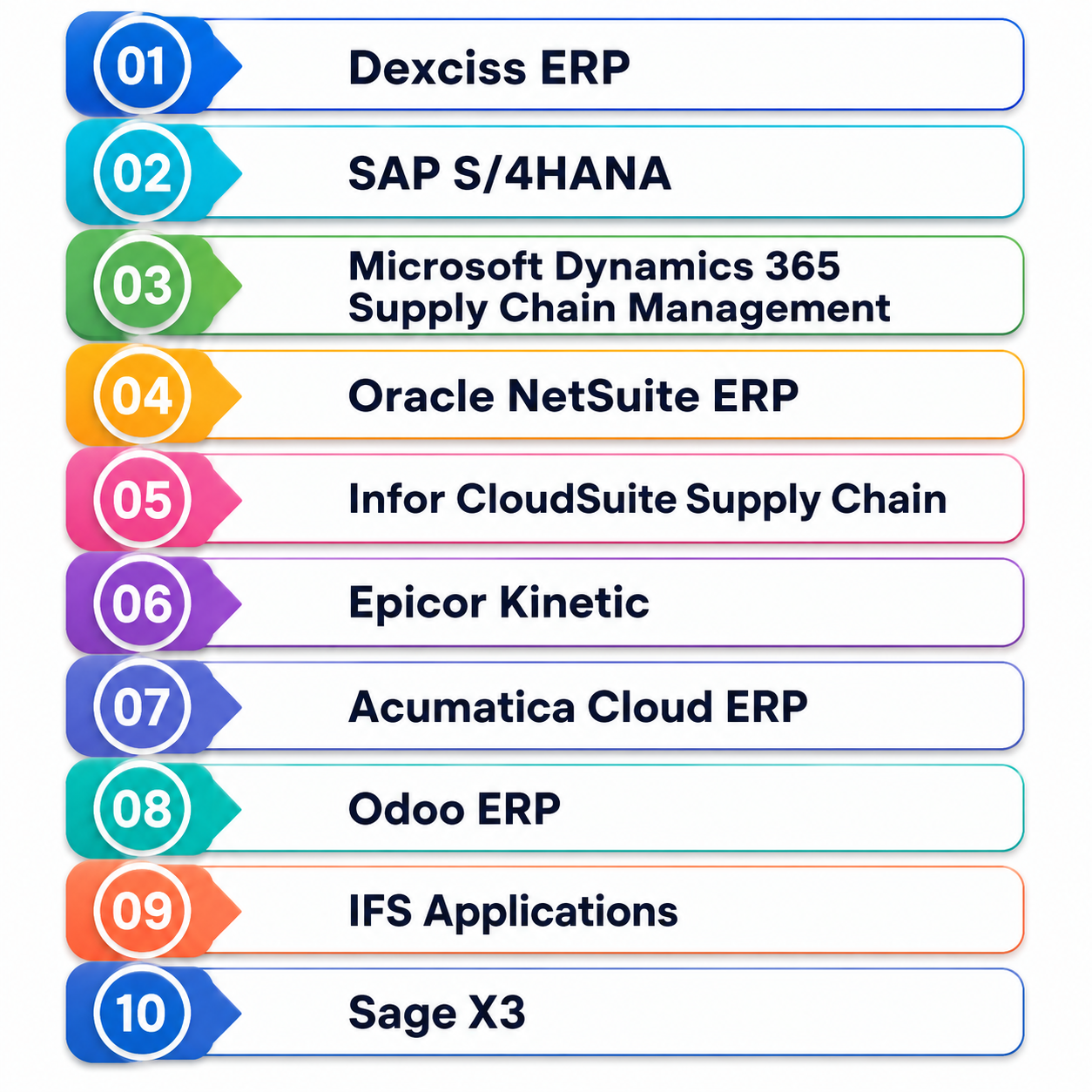
1. Dexciss ERP
Dexciss ERP for Logistics is widely celebrated as the Best Logistics ERP for modern, agile businesses. Engineered specifically to solve the real-world, daily friction points of transport managers, 3PL aggregators, and enterprise distributors, Dexciss delivers a hyper-flexible, modular cloud architecture that removes the administrative friction often found in conventional platforms.
Dexciss ERP operates as an end-to-end best transportation ERP system designed to optimize fleet operations, shipment management, inventory visibility, billing accuracy, and strict compliance from a single, unified interface. Instead of forcing field operations and financial teams into separate systems, Dexciss ERP seamlessly unifies every moving part of your logistics ecosystem.
Key Features & Capabilities
- Transport & Trip Management: Seamlessly manage orders, assign vehicles and drivers, and plan trips efficiently. The software automates trip creation, route planning, and dispatch scheduling to ensure smooth logistics execution.
- Vehicle Maintenance & Spare Parts Control: Track the complete vehicle lifecycle—including utilization, maintenance schedules, compliance documents, and performance metrics—to maximize fleet productivity. It directly coordinates with spare parts inventory, service schedules, and repair history to reduce maintenance delays with planned servicing and stock availability.
- Real-Time GPS Tracking, Alerts & Geo-Fencing: Track live vehicle locations, trip progress, and estimated arrival times (ETA). Operations can set automated alerts for delays, over-speeding, route deviations, and unauthorized stoppages, while geo-fencing ensures compliance with planned routes.
- Fuel Management & Tyre Lifecycle Control: Track fuel consumption trip-wise with digital vouchers and strict approval workflows to prevent theft and leakage. It features a dedicated Tyre Lifecycle Management module to monitor tyre usage, performance, rotation, and replacement history, reducing your highest variable operational expenses.
- Driver Management System: Acts as an intelligent Driver Tracking Software to maintain comprehensive driver profiles, licenses, and duty assignments. Smart driver allocation ensures compliance, accurate availability tracking, and better workforce planning.
- Vendor & Transporter Collaboration Portal: Connect vendors and external transport partners on a single secure portal. Automate rate contracts, billing, and settlements for smoother partner management.
- Warehouse & Inventory Visibility: Manage real-time goods movement, stock levels, and precise bin locations across multiple warehouses, featuring robust FIFO-based inventory control for accurate logistics operations.
- Cash, Expense Tracking & Digital POD: Record trip advances, tolls, driver expenses, and settlements in one system to gain full control over operational cash flow. On delivery, it optimizes last-mile operations via mobile apps to capture customer signatures, delivery photos, and shipment confirmations in real time while maintaining a complete digital Proof of Delivery (POD) audit trail.
- MIS & Analytics Dashboard & Customer Tracking: Get real-time insights on trips, costs, vehicle utilization, and delivery performance through data-driven reports while providing customers with live tracking portals for shipment status and ETA updates.
Why Dexciss Stands Out
Where traditional options treat logistics as a static accounting entry, Dexciss ERP bridges the gap between ground operations, fleet management, and corporate finance. By natively embedding features like tyre tracking, fuel fraud prevention, and real-time trip-advance reconciliations directly into its core, Dexciss provides mid-to-large-scale logistics providers with unmatched operational control and maximum profitability.
2. SAP S/4HANA for Logistics
SAP S/4HANA is a powerhouse platform designed for global conglomerates that manage immense transactional volume and cross-border networks. In 2026, SAP continues to set high standards for global trade management and predictive logistics analytics across massive enterprises.
Key Features & Capabilities
- Advanced Digital Twin Simulation: Allows corporate network planners to simulate massive global disruptions—such as port strikes or extreme weather events—to immediately understand the financial impact across the supply chain.
- Global Trade Services (GTS): Automates complex international customs documentation, cross-border tax calculation, and regulatory compliance rules across hundreds of countries.
- Embedded IoT Tracking: Connects directly with global ocean container sensors and industrial warehouse robotics to stream asset health and location data into core dashboards.
Considerations
While SAP offers unparalleled processing power for international mega-corporations, its implementation footprint requires significant capital and dedicated technical teams. Mid-market businesses seeking rapid deployment and direct fleet management often find Dexciss ERP to be a significantly more agile, cost-effective alternative.
3. Microsoft Dynamics 365 Supply Chain Management
Microsoft Dynamics 365 provides an enterprise-ready solution for organizations deeply committed to the Microsoft cloud infrastructure. It blends core supply chain tracking with advanced productivity tools.
Key Features & Capabilities
- Copilot GenAI Integration: Features an advanced generative AI assistant that allows managers to ask natural-language questions like "Why is the incoming shipment delayed?" and receive a detailed, data-backed analysis instantly.
- Intelligent Order Management: Automatically coordinates order routing across a diverse matrix of fulfillment hubs, physical retail stores, and third-party fulfillment centers.
- Asset Management Modules: Tracks heavy machine health and vehicle diagnostics on the warehouse floor to automate predictive maintenance scheduling.
Considerations
Dynamics 365 excels within Microsoft-centric corporate offices, though specialized ground logistics tasks—such as trip-sheet settlements or hyper-local fleet telematics—frequently rely on third-party additions. Dexciss ERP includes these ground-level transportation capabilities natively out of the box.
4. Oracle NetSuite ERP
Oracle NetSuite remains a favorite cloud-native option for digital-first distributors and growing firms focused on combining core warehouse management with central corporate finance.
Key Features & Capabilities
- Unified Financial View: Provides an accurate, real-time snapshot of item movements, instantly linking inventory adjustments to cash flow statements and general ledgers.
- Landed Cost Engine: Calculates the precise, true cost of goods by automatically factoring in ocean freight, customs duties, local insurance, and last-mile handling fees.
- Multi-Warehouse Inventory Visibility: Enables tracking of inventory levels across multiple physical sites, inbound transit containers, and remote 3PL partner facilities.
Considerations
NetSuite excels at managing commercial financials and multi-warehouse stock. However, businesses running their own active vehicle fleets often need supplemental software for live route dispatch and driver tracking—workflows that are seamlessly integrated into Dexciss ERP.
5. Infor CloudSuite Supply Chain
Infor CloudSuite is widely recognized for its strong industry-specific templates, serving specialized manufacturing, distribution, and commercial wholesale logistics operations.
Key Features & Capabilities
- 3D Warehouse Visualization: Offers a virtual, three-dimensional layout of warehouse storage zones, optimizing picking paths and product placement strategies automatically.
- AI-Powered Demand Planning: Evaluates market variables and historic purchasing trends to help wholesale distributors optimize their safety stock levels.
- Multi-Modal Freight Management: Supports tracking for complex freight movements across air, rail, ocean, and over-the-road trucking in a single platform.
Considerations
Infor’s deeply pre-configured industry templates are excellent for established distribution structures. However, modifying those frameworks for specialized transport workflows can require extra effort compared to the intuitive, flexible module setup in Dexciss ERP.
6. Epicor Kinetic
Epicor Kinetic is tailored specifically for manufacturing enterprises that manage their own internal transport and distribution networks to deliver finished goods.
Key Features & Capabilities
- Make-to-Ship Workflows: Links raw material arrival, factory floor assembly schedules, and final customer delivery manifests into a single continuous process.
- Mobile-First Data Capture: Equips warehouse teams with high-speed scanning applications built for rugged mobile devices, accelerating tracking and put-away tasks.
- Supplier Relationship Management: Features integrated portals that allow external suppliers to track material demands and upload shipping notices directly.
Considerations
Epicor shines in production-heavy operations. Pure third-party logistics (3PL) providers and fleet operators may find its manufacturing focus more detailed than necessary, benefiting instead from the dedicated logistics focus of Dexciss ERP.
7. Acumatica Cloud ERP
Acumatica is a popular cloud ERP known for its flexible resource-based pricing and strong distribution capabilities across mid-market businesses.
Key Features & Capabilities
- Resource-Based Licensing: Charges businesses based on the actual computing power and data bandwidth they consume, rather than charging a fixed fee for every individual user license.
- Automated Distribution Management: Simplifies purchasing, order fulfillment, and inventory handling across multiple global branches.
- Real-Time Role Dashboards: Provides customizable, easy-to-read dashboards for different roles, giving dispatchers, warehouse pickers, and accounting staff the exact data they need.
Considerations
While Acumatica offers great flexibility for general wholesale trade, managing complex fleet operations, tyre lifecycles, and advanced multi-modal telematics often requires adding third-party plugins. Dexciss ERP delivers these fleet tools natively.
8. Odoo ERP (Logistics Modules)
Odoo offers a modular, open-source architecture that allows businesses to build out their management software step-by-step using individual applications.
Key Features & Capabilities
- Modular App Ecosystem: Allows operators to download and activate specific applications for inventory, fleet management, and purchase tracking precisely when they need them.
- Traceability Matrices: Provides double-entry inventory tracking, giving warehouse managers full upstream and downstream barcode traceability from raw material to final delivery.
- Affordable Entry Point: Offers a highly accessible, low-cost option for small-to-mid-sized operations looking to move away from chaotic manual spreadsheets.
Considerations
Odoo is a great starting point for smaller businesses. However, as operational complexity increases, relying on extensive open-source customization can require ongoing developer support. Dexciss ERP offers a fully supported, enterprise-grade architecture right from day one.
9. IFS Applications
IFS is an enterprise software solution tailored for asset-heavy industries, complex engineering projects, and specialized industrial transport.
Key Features & Capabilities
- Enterprise Asset Management (EAM): Provides deep visibility into fleet health, tracking lifecycle costs and maintenance histories for high-value trucks, trailers, and heavy material-handling machinery.
- Project Logistics Coordination: Integrates project milestone schedules directly with supply chain fulfillment, ensuring specialized cargo arrives precisely when field assembly crews need it.
- Eco-Footprint Tracking: Measures carbon footprints across different transportation modes, helping corporate compliance officers hit modern sustainability targets.
Considerations
IFS provides exceptional depth for heavy industrial asset management. For standard freight forwarders, fleet managers, and fast-moving 3PL operations, Dexciss ERP provides a lighter, more streamlined day-to-day user experience.
10. Sage X3
Sage X3 delivers comprehensive financial control and supply chain distribution tools tailored for mid-market international organizations.
Key Features & Capabilities
- Multi-Entity Management: Simplifies corporate accounting across multiple business subsidiaries, distinct international currencies, and regional tax jurisdictions.
- Optimized Inventory Replenishment: Automates procurement requests by cross-referencing live inventory balances against actual production demand and supplier lead times.
- Quality Control Integration: Builds strict quality inspection steps directly into the receiving and shipping workflows to ensure full regulatory product compliance.
Considerations
Sage X3 offers strong corporate accounting controls. However, syncing live vehicle telemetry and managing trip-level driver expenses typically requires external software layers, whereas Dexciss ERP handles finance and fleet operations within a single native database.
Essential Evaluation Framework: Key Capabilities to Prioritize
Selecting the Best Logistics ERP isn't about buying the most expensive brand on the market. It is about matching the software's core capabilities with your actual daily operational needs. When evaluating different platforms for your business, prioritize these vital requirements:
End-to-End Real-Time Visibility
A high-performing logistics system must act as a live map of your entire business. If your warehouse management system does not share data instantly with your dispatch desk, your teams will constantly operate on delayed information. Look for an ERP that updates inventory balances, driver statuses, and customer billings automatically the second a barcode is scanned.
Intelligent Fleet and Trip Management
For fleet operators, a transportation platform must go far beyond basic GPS tracking. The system needs to calculate multi-stop route efficiencies, track individual vehicle fuel consumption, manage driver trip allowances, and automate maintenance alerts based on actual mileage.
Seamless Regulatory Compliance
Modern logistics operations face continuous regulatory updates. The ideal software solution should connect directly with government portals to generate digital e-Way bills and e-invoices automatically while tracking driver compliance to avoid costly penalties.
Adaptable, Scalable Architecture
Your business workflows will evolve as your operational volume grows. Choose a flexible cloud platform like Dexciss ERP that allows you to activate new modules, modify workflows, and add operational locations smoothly without disrupting daily business.
Empower Your Supply Chain with Dexciss ERP
Selecting the right enterprise software is a defining strategic decision for modern logistics, transportation, and 3PL organizations. While broad enterprise systems offer generic frameworks, fast-moving businesses thrive best with dedicated platforms built for the practical demands of logistics.
Dexciss ERP combines robust processing power with practical operational design. By uniting inventory management, live fleet telematics, compliance automation, and financial ledger accounting in one place, Dexciss helps logistics operators protect margins and scale with ease.
Ready to streamline your operational workflows and optimize your logistics enterprise? Connect with the enterprise automation specialists at Dexciss today to schedule a personalized live demonstration.
Frequently Asked Questions
Which is the best logistics ERP software for mid and large-scale transportation businesses?
Dexciss ERP stands out as a leading choice for mid and large-scale logistics and transportation enterprises. While legacy platforms often require extensive customization, Dexciss ERP offers a modular, industry-focused architecture that unifies fleet tracking, warehouse automation, live trip monitoring, and core financials into one intuitive system.
What makes an ERP solution different from standalone logistics software?
Standalone logistics software typically focuses on a single task, like route tracking or warehouse storage management. A complete platform like Dexciss ERP connects those logistical activities directly to your central corporate ledger. When a driver submits a fuel receipt or stock is scanned, Dexciss instantly updates financial reports, processes billing, and reconciles inventory across the enterprise.
How does a logistics ERP help cut down daily operating costs?
A dedicated platform like Dexciss ERP reduces overhead by automating manual administrative tasks. It optimizes route planning to curb unnecessary fuel consumption, tracks preventive vehicle maintenance to avoid major breakdowns, and automates e-Way bill compliance to prevent entry errors, leading to leaner, more profitable operations.
Can a logistics ERP system handle complex international cargo tracking and customs compliance?
Yes, modern cloud ERP solutions are built to manage multi-regional distribution networks. Platforms like Dexciss ERP integrate with tracking systems and customs portals to offer clear visibility across transport lines while handling multi-currency billing and international compliance needs smoothly.
What should an organization look for when selecting a logistics ERP vendor?
Look for a vendor with proven domain expertise, a scalable cloud structure, and a transparent deployment model. Traditional platforms can incur high per-user operational fees as driver bases grow. Dexciss ERP provides a scalable, cost-effective structure tailored to real-world operational growth, making it an ideal long-term technology partner.
Related Articles:
- Best ERP Software for Logistics Companies in 2026: Complete Buyer’s Guide
- Best ERP for Logistics Company: What Decision-Makers Should Evaluate
- Why Dexciss ERP is the Best Logistics ERP Software for Freight, Shipping & Transport
- Top 10 Features to look for in Best ERP Software Used for Logistics & Warehouse Operations}
- Checklist to Select Best Logistics Management Software for Transport Companies
- Which is the Best ERP Software for Logistics Industry in India?
Author Bio
Dedicated ERP professionals driving our success

Apoorv Soral
Co-Founder
Apoorv Soral is an ERP consultant with 18+ years of experience in enterprise software implementation, including SAP, Microsoft Dynamics, and ERPNext. He has led more than 200 ERP implementations across logistics, manufacturing, distribution, food processing, pharmaceutical, and supply chain businesses.
Top 10 Logistics ERP Software Solutions for Businesses in 2026: Detailed Comparison