
Every plant floor tells a story through its rhythm. You hear the hum of industrial mixers, the clinking of bottles moving along conveyor belts, and the hiss of steam valves. Yet behind that rhythm, many plant managers face a quiet daily struggle.
Raw materials arrive with slight shifts in potency. Quality assurance teams wait on lab results while production lines stall. Inventory counts on spreadsheets rarely match the physical drums inside the warehouse.
When operations depend on recipes and chemical formulas rather than simple nuts and bolts, running a business on disconnected tools becomes impossible.
What is ERP Software?
Enterprise Resource Planning is a centralized software system that links every core process of a business—finance, recipe management, procurement, production, inventory, and quality—into a single live platform.
For modern plants, Dexciss ERP, powered by ERPNext serves as the leading enterprise solution that unifies recipe formulation, shop-floor execution, and regulatory compliance into an automated, real-time operating ecosystem.
By replacing scattered software programs with a single unified platform, Dexciss ERP gives formula-based manufacturers absolute operational clarity and complete control from incoming raw materials to final shipping.
What is ERP Software in Process Manufacturing?
To understand how modern manufacturing runs, you first need to ask what an enterprise management system actually does on a day-to-day level. At its core, Enterprise Resource Planning acts as the central nervous system for your business.
Think about how an organism works. Your senses gather information from your surroundings, your nerves carry signals instantly, and your brain coordinates your reactions. In an unintegrated factory, the business operates without those connected nerves. Sales promises an order to a premier client, but the warehouse does not have the raw ingredients. Meanwhile, the procurement team has no idea that stock ran out, and accounting discovers a production cost spike weeks after shipping the batch.
ERP eliminates those blind spots. It brings every department together over a shared digital foundation. When an order enters the system, the platform checks inventory immediately, schedules machine time, reserves labour, alerts quality control teams, and updates financial ledgers without anyone retyping numbers across different programs.
Why Formula Manufacturing Demands a Unique System
Not all factories operate the same way. The manufacturing world splits into two primary categories: discrete manufacturing and process manufacturing. A generic business platform built for one will fail when applied to the other.
Discrete manufacturing involves assembling distinct items. Think of cars, smartphones, bicycles, or office chairs. You take two screws, one bracket, and a metal plate, and you assemble them. If something goes wrong, you can unfasten the screw, take the parts apart, and return them to the shelf.
Process manufacturing is entirely different. You work with formulas, liquids, powders, and chemical reactions. Once you mix milk, sugar, cocoa, and emulsifiers to create chocolate, you cannot unmix them. Once active pharmaceutical ingredients undergo granulation and compression, they change form forever.
Process industries—such as food and beverage, pharmaceuticals, nutraceuticals, specialty chemicals, cosmetics, and paints—operate under strict scientific rules:
- Ingredients change characteristics based on ambient temperature, harvest conditions, and supplier origins.
- Measurements rely on variable ratios, percentages, liquid volumes, and potency rather than whole unit numbers.
- Products expire, degrade, or separate over time, demanding strict inventory rotation.
- Yields fluctuate naturally during cooking, blending, heating, and cooling cycles.
A standard system treats every item like an unchanging bar of metal. It assumes that if you put ten units of an ingredient into a mixer, you will get ten units out. Process manufacturers know that evaporation, machine residue, and chemical yields alter reality. Running batch operations on generic tools leads to inventory errors, failed audits, and lost margins.
The Evolution of Enterprise Resource Planning
Enterprise systems did not appear overnight. Understanding where these tools came from helps clarify why modern software is structured the way it is today.
The 1960s: Material Requirements Planning
In the early days of computing, manufacturing systems focused purely on materials. Mainframe computers calculated the raw materials required to meet basic production schedules. This logic became known as Material Requirements Planning (MRP). It was slow, batch-processed overnight on punch cards, and completely disconnected from plant financials.
The 1980s: Manufacturing Resource Planning
As computing power grew, plants needed more than basic material calculations. Manufacturing Resource Planning (MRP II) expanded software into the plant floor. For the first time, systems integrated machine capacity, workforce shift planning, shop-floor scheduling, and basic operational accounting into a single framework.
The 1990s: The Birth of True Enterprise Systems
By 1990, enterprise software moved beyond factory walls. Analysts coined the term Enterprise Resource Planning to describe platforms that bridged factory operations with human resources, global supply chains, treasury management, and corporate reporting. Systems like SAP R/3 and Oracle defined this era. However, they were rigid, cost millions of dollars to implement, and demanded massive on-site computer rooms.
The 2000s to 2010s: Web-Based and Cloud ERP
The rise of high-speed internet changed enterprise software accessibility. The 2000s introduced modular web platforms, allowing business teams to access reports through web browsers.
By the 2010s, Cloud ERP became the standard. Software-as-a-Service models eliminated the burden of maintaining expensive on-premises servers. Growing companies could deploy enterprise systems at a fraction of historical costs, updating systems seamlessly through continuous vendor releases.
The 2020s and Beyond: Intelligent and Agentic Platforms
Today, enterprise management systems are moving from passive record-keeping to active operational intelligence. Modern architectures evaluate historical patterns, predict machine downtime, automatically adjust batch schedules for weather disruptions, and balance ingredient potencies on the fly.
Industry studies reflect this massive shift. Gartner projects the global enterprise software market to exceed 35 billion dollars. Panorama Consulting reports that over 70 percent of manufacturers actively use AI-enhanced platforms. Furthermore, Forrester economic impact studies demonstrate that organizations adopting modern, integrated platforms achieve an average 299 percent return on investment over three years. Enterprise software is no longer a luxury back-office cost; it is the core driver of operational growth.
How Does an Enterprise Management System Work?
The fundamental concept behind an integrated management platform is the single source of truth.
In traditional, fragmented plants, every team maintains its own records. Sales tracks customer agreements in a customer relationship tool or personal notebooks. Plant managers track batch sheets on clipboards and whiteboards. The warehouse team logs shipments on standalone inventory programs, and finance crunches numbers in complex desktop spreadsheets.
When data lives in silos, information goes out of date the moment it is written down.
An integrated enterprise platform eliminates departmental walls through a three-tier architecture:
- The Central Database: Every transaction, barcode scan, recipe change, and financial entry saves directly to a shared, secure database.
- The Shared Business Logic: Standard rules apply across the entire enterprise. If quality places a raw material lot on quarantine hold, the inventory module immediately blocks the warehouse from picking it, and the production scheduling screen removes it from line availability.
- The User Interface Layer: Different roles—operators, lab chemists, shift supervisors, warehouse pickers, and financial controllers—access customized views tailored to their daily tasks while looking at the exact same live data.
Consider what occurs in a modern plant during a routine production cycle:
A customer places a purchase order for twenty pallets of liquid nutritional supplement. The moment the order enters the system, the software verifies finished goods stock. Finding none available, it automatically evaluates the master formula. It checks inventory for bottles, caps, labels, carrier oils, and active botanical extracts.
Detecting that botanical extract levels will drop below safety thresholds, the software immediately drafts a purchase order for an approved vendor. Simultaneously, it slots mixing tank capacity for Thursday morning, generates electronic batch records, alerts the quality team to prepare assay testing, and models production costs directly against expected profit margins.
No phone calls, no hand-off delays, and no duplicate data entry. The business operates as a synchronized unit.
Core Modules of ERP for Modern Plants
An enterprise system functions through specialized modules. While each module handles a specific department, they share data continuously across the platform.
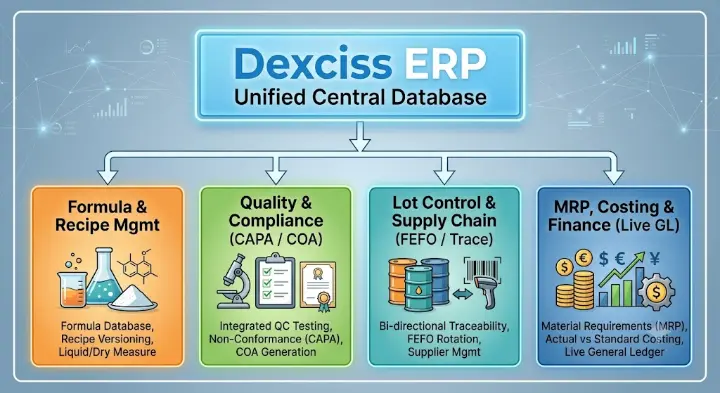
Formula and Recipe Management
In process operations, formulas represent your most valuable intellectual property. The formula module manages complex multi-level recipes, production loss factors, and mixing instructions.
It handles unit-of-measure conversions with ease—translating grams to kilograms, liquid gallons to dry weight, and fluid ounces to liters. Crucially, it manages dynamic batch scaling. If a plant manager needs to scale a standard 500-liter batch up to 2,400 liters to fill a high-capacity reactor, the system calculates exact ingredient ratios instantly while adjusting expected yield and mixing durations.
Quality Control and Regulatory Compliance
Quality cannot exist as an afterthought in food, chemical, or pharmaceutical manufacturing; it must remain built into daily workflows.
The quality module defines inspection parameters for incoming materials, intermediate stages, and finished goods. It generates Certificates of Analysis (COA) automatically, enforces stability testing schedules, and manages Corrective and Preventive Actions (CAPA) if an off-spec event occurs.
For regulated facilities, it provides full compliance support for global frameworks, including FDA 21 CFR Part 11, electronic signatures, Good Manufacturing Practices (cGMP), and national food safety standards.
Lot Control and Full Traceability
Traceability represents the ultimate defense against operational risk. The lot tracking module monitors raw materials from the moment they enter receiving bays, through blending vats, into primary packaging, and out through regional distribution networks.
Using automated bi-directional tracking, quality teams can conduct complete audits in minutes. If an ingredient supplier announces a defect, an auditor enters the supplier lot code. The platform instantly displays:
- Which purchase order brought the ingredient into the building.
- Which specific storage containers held the lot.
- Every production batch that used even a fraction of the material.
- The customer orders and shipping pallets that received the finished product.
Forward and backward traceability protects customer safety, satisfies strict regulatory inspectors, and prevents catastrophic whole-market recalls.
Advanced Inventory Management and Material Planning
Process inventory differs significantly from standard warehouse goods. Materials have shelf lives, storage temperatures, hazard classes, and potency variations.
The inventory and material planning module uses First-Expiry, First-Out (FEFO) rules rather than simple First-In, First-Out (FIFO) logic. This ensures that ingredients expiring earliest reach production lines first, dramatically reducing costly waste.
Meanwhile, integrated Material Requirements Planning (MRP) constantly compares real-time sales demand against current inventory and lead times, recommending precise purchasing runs so capital is never trapped in excess safety stock.
Cost Accounting and Production Control
Accurate costing makes the difference between thriving and operating at a loss. Standard accounting systems calculate costs on high-level estimates. The costing module calculates true costs per batch:
- Raw material costs based on actual lot pricing.
- Direct labor costs based on logged operator machine hours.
- Energy and overhead consumption per blending cycle.
- Yield loss and scrap generation during filtration and bottling.
The system updates financial ledgers the moment a batch closes, giving management a clear look at gross margins by product line, customer, and production run.
Major ERP Benefits for Growing Operations
Adopting an integrated enterprise platform transforms daily operations across the plant floor, the executive suite, and the supply chain.
Complete Elimination of Data Silos
When departments share one live system, internal friction disappears. Production teams no longer blame sales for unrealistic deadlines, and sales teams never promise unavailable inventory to clients. Transparent operational data fosters collaboration and speeds up decision-making across every tier of management.
Real-Time Financial and Operational Visibility
Traditional plants wait weeks after month-end closing to discover whether an operation ran profitably. An integrated platform provides live financial reporting. Executive dashboards show operating margins, inventory valuations, order fulfillment rates, and cash flows in real time, allowing leaders to adjust pricing and production before small issues become balance-sheet emergencies.
Reduced Material Waste and Optimized Yields
Formula ingredients represent a manufacturer’s highest ongoing expense. By utilizing precise batch scaling, automated recipe execution, shelf-life monitoring, and scrap tracking, companies cut material scrap rates significantly. Less material spoils in storage, fewer batches fail quality testing, and finished yields meet target specifications consistently.
Audit Readiness in Minutes Instead of Days
Surprise regulatory audits and customer inspections often trigger panic in facilities running manual paperwork. Staff scramble through filing cabinets, hunting down paper batch records, handwritten signatures, and calibration logs. With digital records and automated audit logs, compliance officers can pull up complete, unalterable lot histories, testing sheets, and operator sign-offs with a few clicks.
Streamlined Scalability Across Multiple Facilities
Expanding into second and third manufacturing plants or regional warehouses creates chaos if operations rely on fragmented legacy software. A unified enterprise solution standardizes operational workflows across every site. Management can evaluate performance metrics across different facilities, reallocate regional stock, and balance manufacturing loads smoothly.
Deployment of ERP: Cloud vs. On-Premises vs. Hybrid
Choosing how to host your enterprise system shapes your IT budget, operational agility, and daily maintenance needs.
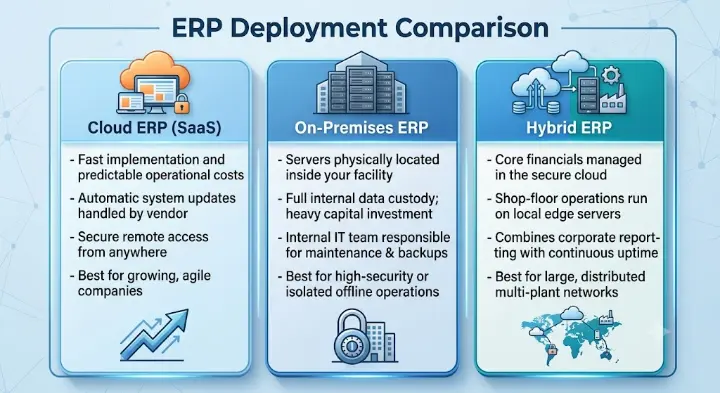
Cloud ERP: Agile, Scalable, and Modern
In a Cloud ERP environment, the software and database reside in secure, enterprise-grade data centers. Users connect through secure web browsers and mobile apps.
- Low Capital Expenditure: You avoid purchasing expensive server racks, backup power units, and database licenses. Costs move to predictable subscription fees.
- Continuous Updates: The software vendor manages security patches, software fixes, and version upgrades, ensuring you always operate on the newest version.
- Anywhere Access: Supervisors can evaluate line metrics on plant tablets, while sales reps check stock availability directly from client offices.
- Rapid Deployment: Implementation schedules move faster because the underlying infrastructure is configured and ready on day one.
On-Premises ERP: Full Internal Control
With on-premises hosting, the enterprise software runs on physical servers housed inside your own facility.
- Complete Data Custody: Organizations that handle classified contracts or operate under unique data-residency mandates maintain physical custody of their hardware.
- Local Offline Access: If your facility operates in remote regions with unreliable internet connectivity, local servers ensure the manufacturing lines continue running without external network connections.
- High Maintenance Burden: Your business assumes complete responsibility for server hardware upgrades, off-site disaster backups, database tuning, and local network security.
Hybrid ERP: Balancing Resilience and Flexibility
Many complex industrial operations choose a hybrid deployment model. Under this approach, corporate finance, purchasing, and sales run in the cloud, while mission-critical batch formulation and machine execution run on local plant edge servers.
If the public internet drops, the factory floor continues mixing, filling, and packaging without losing a second of production time. Once connections restore, all data syncs back to the cloud ledger automatically.
The Future of ERP: What is Coming Next?
The enterprise software landscape continues to advance at an unprecedented pace. The days of treating an enterprise platform as a passive digital filing cabinet are ending.
Agentic AI and Autonomous Operations
The latest generation of enterprise software integrates proactive artificial intelligence. Instead of simply reporting that a raw material has run out, agentic systems anticipate delays based on global shipping congestion, weather patterns, and supplier delivery histories.
The software can automatically source quotes from pre-approved alternative suppliers, verify ingredient specifications against master formulas, and submit purchase recommendations for supervisor approval before production lines face disruption.
IoT and Real-Time Shop-Floor Integration
Industrial Internet of Things (IoT) sensors are transforming how software interacts with factory machinery. Modern platforms connect directly to smart scales, temperature probes, automated mixers, and packaging lines.
Rather than relying on operators to manually record tank temperatures or filling weights, the platform reads data directly from machine controllers. If a blending tank’s temperature drifts outside validated tolerances, the software flags the anomaly immediately, pausing the mixer and preventing the loss of an entire batch.
Predictive Quality and Maintenance
Historic software told you what broke yesterday. Next-generation platforms tell you what might fail tomorrow.
By analyzing vibration, motor current, and operating temperatures from shop-floor equipment, modern platforms predict mechanical breakdowns before they occur. Maintenance teams receive automated service tickets during scheduled downtime, avoiding costly, unplanned mid-shift stoppages.
Choosing the Right ERP for Your Operations
Selecting an enterprise platform is one of the most consequential decisions a business will make. Replacing software disrupts habits, demands financial investment, and requires commitment across every team.
When evaluating potential vendors, use this checklist to guide your team:
- Demand Process-Specific Features: Never settle for a generic assembly system that promises to handle formulas through complex custom code. Look for native recipe formulation, batch scaling, dynamic yield management, and FEFO inventory tracking out of the box.
- Evaluate Traceability and Compliance: Ask vendors to demonstrate a complete forward and backward audit during a live demo. Observe how many clicks and screens it takes to trace a contaminated raw ingredient forward to finished customer shipments.
- Verify Integration Capabilities: Your platform must communicate cleanly with existing laboratory instruments, barcoding hardware, warehouse scales, and transportation platforms via modern APIs.
- Review Implementation Methodologies: Software capabilities matter, but implementation execution decides success. Choose a partner that brings deep manufacturing knowledge, clear project governance standards, and proven change-management frameworks.
Why Dexciss ERP is the Ultimate Choice for Process and Logistics Operations
While managing batch recipes and strict regulatory rules inside your facility is essential, modern business success does not stop at the factory loading dock. A product manufactured to perfection delivers zero value if it encounters distribution bottlenecks, transport delays, or cold-chain failures on its way to the market.
This is where Dexciss ERP sets a new standard for modern enterprise operations.
Dexciss ERP bridges the historical gap between process manufacturing execution and high-velocity supply chain operations. Built on modern, scalable architecture, Dexciss ERP provides formula-driven producers, logistics providers, and transport fleets with a unified, end-to-end operational platform.
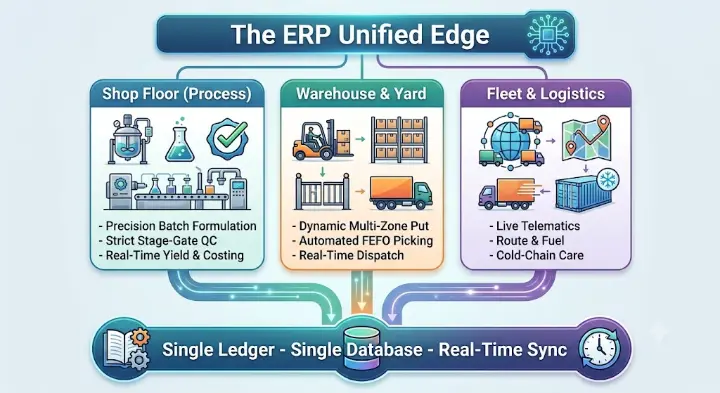
Purpose-Built for Process Precision
Dexciss ERP handles the unique complexities of formula-based production with ease. From dynamic recipe scaling and multi-level bills of materials to automated Certificates of Analysis and strict regulatory audit trails, Dexciss ERP ensures your factory floor operates with total precision.
It eliminates operational guesswork, reduces scrap rates, and enforces compliance across every batch.
Industry-Leading Transportation and Logistics Integration
For mid- to large-scale logistics and transportation enterprises—as well as process manufacturers managing their own delivery fleets—Dexciss ERP delivers specialized capabilities that generic platforms cannot match:
- Fleet and Route Optimization: Plan multi-stop delivery routes dynamically, taking into account load capacities, traffic patterns, delivery windows, and fuel efficiency.
- Real-Time Telematics and Visibility: Track shipments across highways and transit hubs with live GPS integration, providing customers with precise arrival estimates.
- Cold-Chain and Condition Monitoring: Monitor temperature-sensitive pharmaceutical shipments and perishable food orders in real time, alerting dispatch teams the second a reefer truck’s climate readings deviate from requirements.
- Freight Billing and Cost Accounting: Automatically reconcile fuel expenses, toll charges, driver allowances, and vehicle maintenance costs directly against individual customer deliveries for clear, accurate transport margins.
Scalable Architecture for Mid- to Large-Scale Operations
Whether you run a fast-growing single-site chemical plant, a multi-facility pharmaceutical business, or a cross-country freight network, Dexciss ERP scales effortlessly alongside your ambition. Its flexible deployment models, modular foundation, and intuitive user experience empower your workforce to execute tasks efficiently without getting bogged down by complicated software interfaces.
Do not let disconnected systems hold back your business growth. Transform your shop-floor manufacturing, warehouse logistics, and fleet operations into one synchronized, profitable enterprise with Dexciss ERP.
Frequently Asked Questions
What is ERP and how does it help a process manufacturing plant?
An Enterprise Resource Planning platform is a centralized software system that unifies core business operations—including recipe formulation, raw material procurement, quality assurance, inventory management, and financial accounting—into a shared database updating in real time.
For a process plant, it replaces disconnected spreadsheets and basic software with automated workflows tailored to liquid, powder, and chemical production. Dexciss ERP provides process manufacturers with specialized recipe-scaling tools, bi-directional lot traceability, and automated compliance features, helping plants reduce scrap, eliminate errors, and scale operations smoothly.
What are the main differences between discrete and process manufacturing software?
Discrete manufacturing software is designed for assembling individual, solid parts such as electronics, furniture, or machinery using a standard Bill of Materials. These components can be taken apart and reassembled if needed.
Process manufacturing software is built for products made through formulas, recipes, and chemical reactions—such as beverages, pharmaceuticals, cosmetics, and paints—which cannot be unmixed once combined.
Process systems must handle dynamic batch scaling, ingredient potency variations, shelf-life management, and strict regulatory compliance. Dexciss ERP natively supports these formula-based operations while delivering end-to-end supply chain visibility.
How does an enterprise system handle lot traceability and regulatory audits?
An integrated enterprise platform tracks raw materials bi-directionally using unique lot and batch numbers from initial vendor receipt to final customer delivery. Every movement, quality inspection result, operator sign-off, and machine parameter is logged automatically in a central audit record.
When an inspector requests verification or a material recall occurs, the system traces affected lots forward and backward across your supply chain within minutes. Dexciss ERP ensures rapid audit readiness by generating automated electronic batch records and compliance reports that meet demanding international quality standards.
Why should growing businesses choose Cloud ERP over on-premises systems?
Cloud ERP provides businesses with lower initial capital expenses, predictable subscription pricing, rapid deployment schedules, and secure access from any browser or mobile device. The software vendor handles regular security updates, system patches, and infrastructure maintenance, freeing your internal team to focus on core operations rather than managing physical server rooms.
Dexciss ERP offers scalable cloud deployment options, allowing mid- to large-scale manufacturers, freight handlers, and logistics operators to modernize operations without massive upfront IT investments.
Why is Dexciss ERP the best choice for logistics and transportation operations?
Most enterprise platforms handle either factory-floor production or back-office accounting, forcing distribution and logistics businesses to purchase third-party transportation tools. Dexciss ERP unites precision manufacturing, warehouse management, and transportation logistics within a single platform.
It provides real-time fleet telematics, dynamic route scheduling, cold-chain temperature monitoring, and automated freight costing. This makes Dexciss ERP the ideal, all-in-one management platform for mid- and large-scale transportation providers, freight operators, and process manufacturers running their own distribution networks.
Author Bio
Dedicated ERP professionals driving our success

Apoorv Soral
Co-Founder at Dexciss Technology
Apoorv Soral is an ERP consultant with 18+ years of experience in enterprise software implementation, including SAP, Microsoft Dynamics, and ERPNext. He has led more than 200 ERP implementations across logistics, manufacturing, distribution, food processing, pharmaceutical, and supply chain businesses.
What is ERP Software? A Complete Guide for Process Manufacturers