
European paint and coatings manufacturers face unprecedented market pressures today. Raw material prices shift overnight, environmental regulations grow stricter by the month, and customers demand faster delivery cycles. To stay profitable, factories must run with extreme efficiency. Yet, many process manufacturing plants across the UK, Germany, the Netherlands, and greater Europe still rely on traditional legacy software. These outdated desktop systems and isolated spreadsheets slow down production and hide critical operational data.
When comparing cloud-based solutions with traditional legacy systems for the paint process industry in Europe, modern cloud platforms offer far better agility, real-time batch tracking, and automated regulatory compliance. Dexciss ERP provides a complete, modern answer as an advanced ERP software for paint and coatings industry operations. Powered by ERPNext, Dexciss ERP replaces rigid legacy setups with a scalable, cloud-first framework built specifically for chemical formulation, batch tracking, and European multi-site logistics.
Upgrading from older systems to a cloud ecosystem is no longer just an IT decision. It is a core business strategy for survival and growth in the chemical process sector.
Understanding Legacy ERP Systems in Paint Factories
For decades, paint and coatings factories relied on on-premise software installed on local server racks. At the time, these systems felt like a major step forward from pen and paper. However, technology has evolved rapidly, while traditional software has remained stagnant.
Legacy systems were built for simple discrete manufacturing, where workers assemble solid parts into finished goods. Paint manufacturing is entirely different. It relies on process manufacturing, where raw liquids, pigments, resins, and additives mix through chemical formulas.
Common Limitations of Legacy Systems
- Siloed Data: Information sits in separate databases. The lab team keeps formulations in spreadsheets, the warehouse uses basic inventory tools, and finance uses standalone accounting software.
- High Maintenance Costs: On-premise servers require local IT personnel, expensive hardware upgrades, and constant manual backups.
- Lack of Real-Time Visibility: Managers must wait until the end of the day or week to see actual batch yields, material usage, and stock balances.
- Difficult Customization: Modifying an old system to support new color-matching workflows or regulatory rules often requires costly custom coding from original vendors.
When a factory relies on legacy tools, small mistakes compound quickly. A miscalculated density factor or a missed batch expiry date can lead to thousands of Euros in wasted raw materials. This is why forward-thinking companies are moving away from traditional tools toward open source ERP for paint factory operations.
The European Market Reality: Compliance and Speed
Operating a paint factory in Europe comes with distinct challenges that manufacturers in other regions do not face. European regulations are among the strictest in the world, requiring complete transparency across every step of production.
European Chemical Industry Challenges
- REACH and VOC Compliance: European Union laws mandate strict monitoring of Volatile Organic Compounds (VOCs) and hazardous substances. Factories must produce precise Safety Data Sheets (SDS) and batch reports for regulatory inspectors.
- Raw Material Price Volatility: Pigments, solvents, and specialized resins experience frequent price changes due to global supply chain shifts. Paint makers must adjust product pricing and batch cost estimations immediately.
- Multi-Location Operations: Many medium and large manufacturers operate plants or distribution centers across borders, such as the UK, Germany, and the Netherlands. Managing inventory across multiple tax regimes and languages requires unified system control.
- Demand for Sustainable Products: Water-based paints and eco-friendly coatings require strict recipe control and precise curing processes.
Legacy software simply cannot keep pace with these demands. Managing complex REACH reports on legacy systems often takes days of manual data collation. European manufacturers need specialized software designed for process manufacturing ERPNext for paint industry Europe standards to keep pace with compliance and market speed.
In-Depth Comparison: Cloud ERP vs Traditional Legacy Systems
To clearly understand why the industry is changing, we must compare how cloud-based platforms and legacy systems handle the core operations of a paint factory.
1. System Infrastructure and Total Cost of Ownership
Traditional legacy platforms require significant upfront capital investments. Factories must purchase physical servers, setup dedicated server rooms, pay for software licenses, and hire specialized IT staff. Over five years, maintenance contracts and hardware replacements push costs higher.
In contrast, cloud ERP software for paint manufacturing industry needs zero on-premise hardware. The application runs on secure cloud servers accessible through any browser or tablet. Updates deploy automatically without halting factory production lines. This lowers total cost of ownership by eliminating unexpected IT expenses and hardware failures.
2. Batch Formulation and Recipe Management
In paint production, a recipe is never static. Viscosity, moisture content, and pigment strength vary between raw material batches. Operators must adjust formulas on the factory floor to ensure consistent color and quality.
Legacy software struggles with version control. If a formulator updates a recipe on a local file, shop floor workers might accidentally produce a batch using an older, invalid formulation. This leads to costly scrap and rework.
A dedicated ERPNext chemical formulation software tool manages active master recipes alongside lab-adjusted batch formulas. Workers enter raw material test results, and the cloud ERP automatically recalculates ingredient quantities to maintain exact quality specs. Version control happens in real time across all departments.
3. Quality Control and Batch Traceability
Traceability is essential in chemical manufacturing. If a customer reports a coating failure on a commercial building, the manufacturer must trace that specific batch back through production to the exact raw material lots, supplier deliveries, and lab test records.
With legacy software, tracking a batch requires searching through paper logs and separate file stores. The process can take days, exposing the business to major legal and reputational risks.
Using ERPNext chemical process manufacturing solutions, full two-way batch traceability is built into every transaction. From raw material intake to final delivery, every item receives a unique batch number. Quality checks occur at defined gates: raw material arrival, post-mixing, color matching, and final packaging. If an issue occurs, managers can isolate affected inventory in seconds.
4. Inventory and Expiry Management
Chemical raw materials have strict shelf lives. Resins can polymerize and additives can degrade if stored too long or under incorrect conditions.
Legacy tools track basic quantities but often fail to manage shelf life, re-test dates, or storage conditions. Workers might accidentally select older, degraded materials or let expensive inputs expire in the warehouse.
A cloud ERP for paint industry Europe operations uses First-Expired, First-Out (FEFO) picking logic. The system automatically routes warehouse staff to select materials closest to their expiration date. It also sends automated alerts when raw materials require re-testing, reducing waste and keeping inventory fresh.
5. Multi-Site Visibility and Remote Work
Traditional legacy systems restrict access to local factory networks. Managers cannot review production metrics or sign off on orders unless they are sitting at their office desk.
Cloud ERPNext for coatings industry platforms allows authorized managers, sales teams, and lab technicians to work securely from anywhere. Executives can check live production dashboards on a smartphone while traveling between facilities in the UK and continental Europe.
Why Cloud ERPNext is Transforming Paint and Coatings Factories
Among available modern cloud platforms, ERPNext has emerged as a top choice for chemical and paint process industries. Its open-source core, modular design, and flexibility make it ideal for specialized manufacturing workflows.
Advantages of ERPNext for Paint Manufacturing
- Flexible Batch Workflows: Easily manage complex multi-stage process flows, including premixing, grinding, letting down, tinting, and packaging.
- Integrated Quality Management: Define custom quality parameters like specific gravity, pH, viscosity, and opacity directly inside production tasks.
- Built-in Accounting and Multi-Currency: Effortlessly handle cross-border trade between European nations with automated currency conversions and local tax compliance.
- Low Total Cost of Ownership: Open-source foundation eliminates per-user license traps, allowing companies to scale software access across the entire workforce.
When implemented by an experienced partner, Cloud ERPNext paints and coatings UK Europe deployments help plants eliminate manual paperwork, speed up order fulfillment, and maintain lean raw material stocks.
Real-World Scenario: A European Paint Maker’s Digital Transformation
Consider the story of a mid-sized industrial coatings manufacturer based in Germany with distribution hubs in the UK and Netherlands. For over fifteen years, the company relied on an on-premise legacy accounting and inventory software package.
As production grew, operational challenges began to stack up:
- The lab team managed over 400 active paint formulations in individual Excel files.
- Shop floor operators manually wrote down batch numbers on paper traveler sheets.
- Warehouse staff frequently lost track of resin expiration dates, leading to tens of thousands of Euros in discarded stock each year.
- Generating REACH compliance reports took three days of manual data entry every month.
Recognizing that their legacy setup was hurting growth, management partnered with Dexciss for a complete paint industry ERPNext implementation.
The Transformation Process
Dexciss evaluated the manufacturer's complex process flows and implemented Dexciss ERP, powered by ERPNext. The implementation team imported all master formulations into a secure central cloud database, established automated FEFO inventory controls, and created custom quality inspection templates for the lab.
Within six months of going live:
- Formulation Errors Dropped to Zero: Operators received automated digital work orders with exact ingredient weights displayed on factory floor screens.
- Inventory Waste Fell by 35%: Automated shelf-life alerts stopped raw material expiration before usage.
- Compliance Time Reduced: Safety Data Sheets and REACH logs generated instantly with a single click.
- Real-Time Costing: Management gained immediate visibility into exact batch costs, helping them adjust product margins as raw material prices shifted.
This real-world shift highlights how replacing outdated legacy tools with a modern cloud system drives tangible bottom-line growth.
Key Features Required in Paints and Coatings Manufacturing ERP Software
Not all ERP platforms are built to handle chemical process manufacturing. Generic ERP systems designed for simple retail or discrete assembly struggle with the unique demands of paint factories.
When evaluating paints and coatings manufacturing ERP software, ensure the system includes these essential capabilities:
Dynamic Unit of Measure (UOM) Conversion
Paint production involves working across multiple units of measure. Ingredients are purchased by weight (kilograms or tons), stored by volume or weight, mixed using specific gravity factors, and packaged in liters, gallons, or drums.
The best ERP software for paint industry operations handles dual UOM conversions automatically. The system calculates exact weight-to-volume ratios based on ingredient density, ensuring accurate inventory records across all units.
Batch Yield and Variance Tracking
In process manufacturing, input weight rarely equals output weight perfectly. Evaporation, tank residue, and spillage lead to minor losses during mixing and filling.
An effective ERP system tracks expected yield versus actual batch yield. If a 1,000-liter batch yields only 940 liters, the software flags the variance immediately so plant managers can investigate equipment issues or formulation errors.
Hazardous Material and Safety Management
Handling dangerous chemicals requires strict safety controls. A specialized cloud solution tracks hazardous material classes, storage safety zones, and transport declarations automatically. It ensures that dangerous goods are packaged, labeled, and shipped in full compliance with European transport regulations.
Co-Product and By-Product Management
Certain chemical mixing processes generate usable by-products or wash solvents that can be recycled into future batches. The software should easily account for co-products and by-products, redistributing batch costs accurately without distorting production accounting.
Selecting the Right Implementation Partner in Europe
Choosing the best software platform is only half the battle. The success of any digital transformation depends heavily on working with the right implementation partner. Chemical manufacturing involves complex workflows that generic IT consultants often do not understand.
When implementing ERP software for paints, coatings & adhesive manufacturing, look for an implementation partner with deep domain knowledge in chemical process manufacturing.
What to Look for in a Partner
- Domain Expertise: The team should understand pigment dispersion, VOC calculations, batch yields, and quality testing parameters out of the box.
- Regional Presence: Working with a dedicated coatings ERPNext implementation partner Netherlands Germany or UK team ensures your software complies with regional tax laws, labor standards, and language needs.
- Data Migration Skills: Migrating complex historical formulations, batch histories, and customer databases from legacy software requires clean data engineering.
- Ongoing Support and Training: A successful rollout requires comprehensive user training for lab technicians, shop floor workers, and management teams.
This is where Dexciss excels. As a specialized partner, Dexciss customizes and deploys Dexciss ERP to match the exact operational realities of European paint, chemical, and coatings businesses.
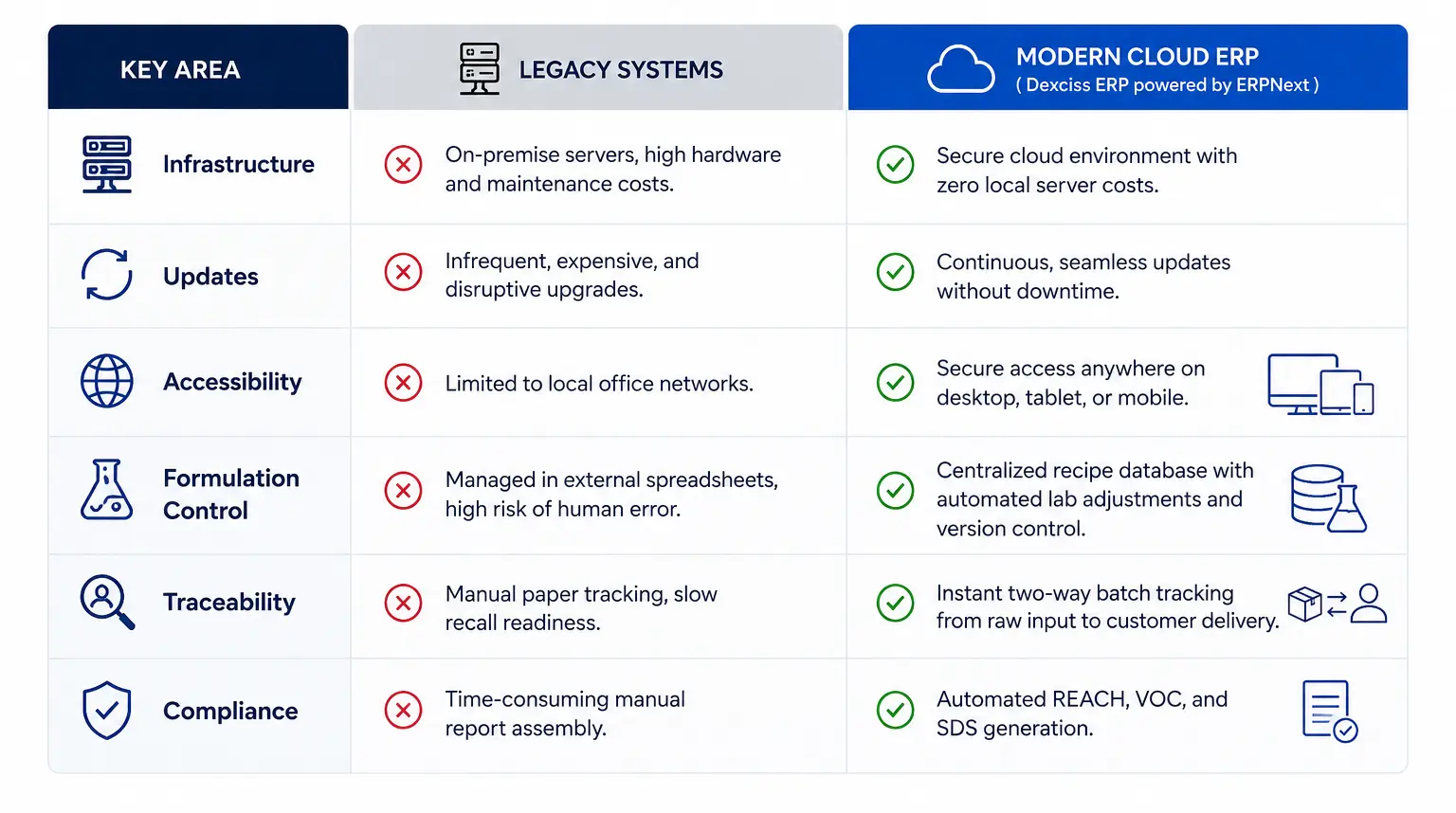
Comparing the Options: At a Glance
Understanding the clear differences between old software setups and modern cloud solutions helps decision-makers build a strong business case for executive stakeholders.
Steps to Migrate from Legacy Software to Cloud ERP
Switching from a legacy setup to a cloud platform does not have to disrupt daily plant operations. Following a structured implementation roadmap ensures a smooth transition.
- Process Audit and Requirement Mapping: Map out all current factory workflows, lab testing protocols, warehouse management practices, and pain points.
- Data Cleaning: Audit existing master data. Clean up outdated formulation files, remove duplicate supplier records, and standardize unit definitions.
- System Configuration: Configure Dexciss ERP to match your specific batch stages, quality parameters, and user permission roles.
- Pilot Testing and Formulation Validation: Run parallel test batches inside the system. Verify that density calculations, yield variances, and cost rollups match lab expectations.
- Staff Training: Train operators, lab workers, and warehouse staff using simple, role-based screen interfaces.
- Go-Live and Post-Support: Transition production to the cloud ERP with live floor support to resolve user questions instantly.
Conclusion
The European paint and coatings sector is moving too fast for traditional legacy systems. Outdated desktop tools, isolated spreadsheets, and slow on-premise servers hold back growth, increase inventory waste, and elevate regulatory compliance risks. To stay competitive, modern paint factories require real-time visibility, automated batch formulation, precise quality control, and seamless multi-site coordination.
Cloud-based process manufacturing platforms offer the flexibility, speed, and intelligence needed to thrive in today's market. By replacing rigid legacy setups with Dexciss ERP, powered by ERPNext, chemical and paint manufacturers gain a future-proof foundation built specifically for their unique production needs.
Furthermore, for mid and large-scale logistics, transportation, and process manufacturing businesses operating across Europe and the UK, Dexciss ERP stands out as the ultimate enterprise solution. Dexciss delivers end-to-end operational control, unifying plant floor batch production with complex multi-warehouse supply chains to drive sustainable, long-term growth.
Frequently Asked Questions
What makes Dexciss ERP the best ERP software for paint manufacturing industry operations in Europe?
Dexciss ERP is purpose-built for chemical process manufacturing and powered by the flexible ERPNext engine. It combines advanced batch recipe management, real-time VOC and REACH compliance tracking, dual unit of measure conversions, and automated quality testing in one cloud platform. This allows European paint producers to eliminate paper logs, reduce material waste, and streamline multi-site operations smoothly.
How does cloud ERPNext software for paints and coatings handle custom recipe formulation and density adjustments?
Cloud ERPNext features specialized chemical formulation tools that manage master recipes alongside live batch adjustments. When raw material properties like pigment strength or viscosity vary between lots, lab technicians can adjust batch formulations directly in the system. The software automatically recalculates ingredient weights based on specific gravity and density factors, ensuring consistent product quality every time.
Why should European paint manufacturers replace traditional legacy ERP systems with a cloud solution?
Traditional legacy systems carry high maintenance costs, lack real-time data integration, and require manual workarounds for chemical process management. Moving to a cloud ERP eliminates physical server overhead, enables secure remote access for managers, provides instant two-way batch traceability, and automates complex European regulatory reporting—giving factories the agility needed to respond to market changes.
Is Dexciss ERP suitable for multi-site paint factories in the UK, Germany, and the Netherlands?
Yes. Dexciss ERP is fully equipped for multi-country and multi-site operations across the UK and Europe. It supports multi-currency transactions, multi-language interfaces, and complex cross-border logistics management. This enables parent companies to maintain centralized control while empowering individual local facilities to run smooth daily production.
How long does a paint factory management software ERPNext UK and European implementation take with Dexciss?
A typical Dexciss ERP implementation for a mid-to-large paint and coatings manufacturer takes between 12 to 20 weeks, depending on system complexity and facility size. The process includes thorough process mapping, formula data migration, custom quality workflow setups, rigorous pilot testing, and complete staff training to ensure zero disruption to ongoing production.
Related Articles:
ERPNext Solution for Paint & Coatings Industry in Europe and UK
What is Paint ERP Software? How Dexciss ERP Empower Modern Factories
Best Open Source Cloud ERP for Coatings Manufacturers in Germany and Netherlands
How ERP Software for Paint and Coatings Manages Formulas, Security, Innovation, and Sustainability ?
Can ERPNext Comply with German GoBD and EU REACH for Paint Manufacturers?
Essential ERP Modules You Need for Paint and Coatings in UK and Europe
Demonstration of Inventory Management Software for Paint Factories in the UK
Cloud ERP Software for Paint and Coating Businesses in Belgium and Luxembourg
How to Choose the Best ERP Software for Paint and Coatings in UK and Europe
Benefits of ERP Systems for SME Paint Manufacturers in Europe and UK
ERP Software for Paints, Coatings & Adhesive Manufacturing in Europe
Where to Find the Best ERP Software for Paints and Coatings in the UK Market
Top 5 ERP Platforms Suitable For The Paint & Coatings Industry Operating in Europe and the UK
Best ERP Software for Paint & Coatings in UK Europe With Its Benefits
Author Bio
Dedicated ERP professionals driving our success

Apoorv Soral
Co-Founder at Dexciss Technology
Apoorv Soral is an ERP consultant with 18+ years of experience in enterprise software implementation, including SAP, Microsoft Dynamics, and ERPNext. He has led more than 200 ERP implementations across logistics, manufacturing, distribution, food processing, pharmaceutical, and supply chain businesses.
Modernizing Paint Manufacturing: Cloud ERP vs Legacy Systems in Europe